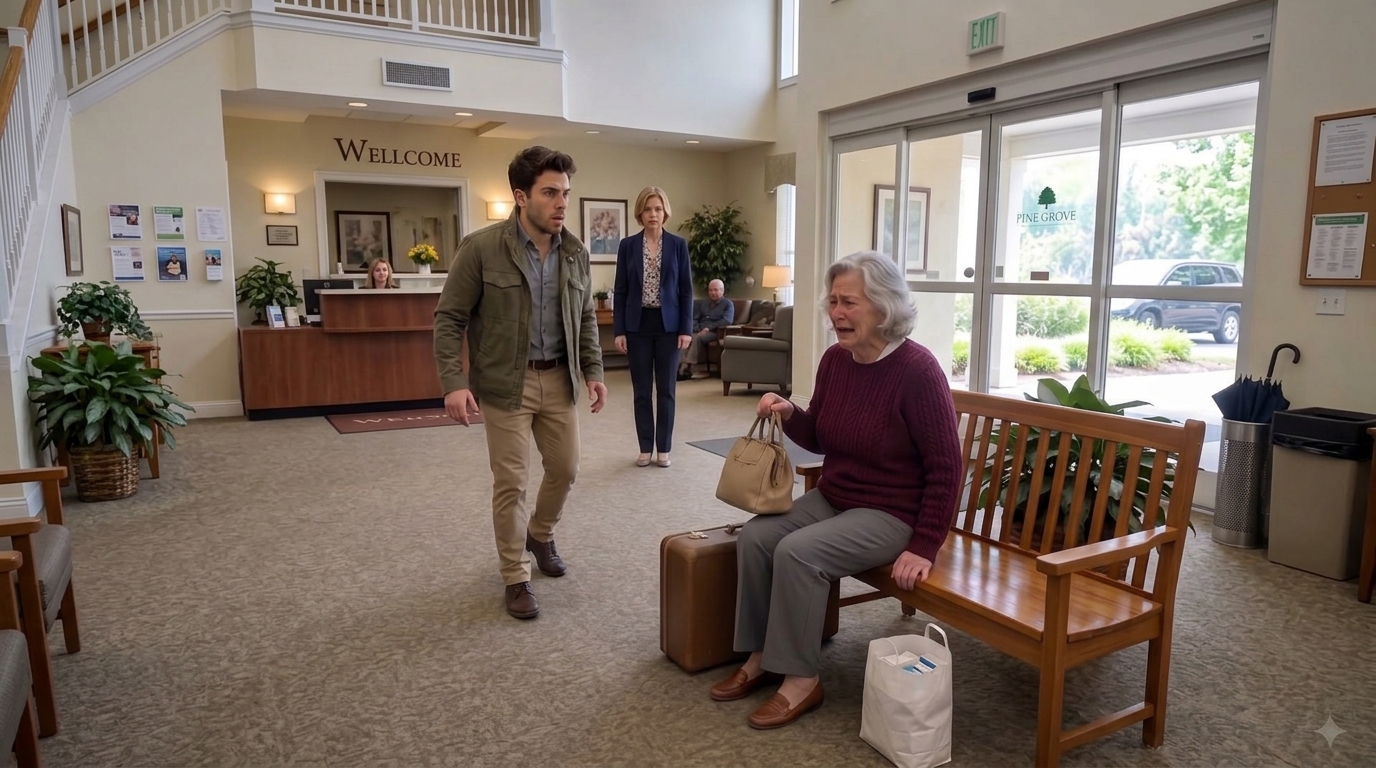
My parents promised Grandma Eleanor they were taking her to lunch. Three hours later, a nursing facility called me and said my eighty-one-year-old grandmother had been abandoned in its lobby with one suitcase, a grocery bag of medication and admission papers describing her as mentally incompetent.

Part 1: The Lunch That Ended With Her Abandonment
I was standing in my Indianapolis apartment when the administrator asked whether I was Daniel Mercer. She explained that my parents had claimed Grandma could no longer bathe, dress or make decisions without supervision.
“Did my grandmother agree to live there?”
“No,” the administrator said. “She believed they were stopping for lunch after touring the garden.”
My father had carried her suitcase inside while my mother distracted her with paperwork. Then they said they needed insurance cards from the car, slipped out through a side entrance and stopped answering their phones.
I drove 190 miles without stopping. When I arrived, Grandma was sitting beneath a cheerful WELCOME HOME banner while two employees tried to determine whether they were legally permitted to let her leave.
Her gray hair was still pinned neatly, but the humiliation showed in the way she held her coat closed with both hands. My mother had told the staff Grandma became manipulative whenever relatives challenged her confusion.
“She said you might invent accusations against them,” the administrator explained carefully. “She warned us not to believe everything you said.”
Grandma looked directly at me. “Your mother wanted strangers to distrust me before I opened my mouth.”
The facility had refused admission because the medical records were incomplete and Grandma had clearly objected. Once her identity was confirmed, she walked beside me to the car and fastened her seatbelt without asking where my parents had gone.
“Don’t call them,” she said. “They’ve already had enough time to lie.”
She directed me to the county recorder’s office before handing me a bank statement. Three withdrawals totaling fifty-five thousand dollars had been circled in red, all authorized through the temporary power of attorney she had given Dad after hip surgery.
Grandma had confronted him that morning. Dad responded that his contracting company employed younger people with children, while she was “hoarding money for a future she didn’t have.”
Mom had been even colder. She said an old woman living alone in a three-bedroom house was selfish and embarrassing when her own son was struggling to keep his business alive.
“She asked what I expected to do with the house when I was dead,” Grandma told me. “Then she reminded me that coffins don’t come with garages.”
I nearly called Mom, but Grandma placed one hand over my phone. She removed an envelope marked HOUSE DEED from inside her coat and said my late grandfather had once warned her never to leave the original where Dad could find it.
We reached the recorder’s office minutes before closing. The clerk searched Grandma’s address, frowned at the screen and printed a quitclaim deed recorded twelve days earlier.
The document transferred Grandma’s home to my father. Her name appeared at the bottom beside a notary’s seal, but she had never met the notary and had not signed the page.
The clerk then found a lien recorded four days later. Dad had used the stolen title to pledge Grandma’s home as collateral for a $160,000 business loan.
My phone rang before we reached the parking lot. Dad did not ask whether Grandma was frightened, whether she had eaten or whether she still had her medication.
“Where is she?” he demanded. “You cannot take her back to that house.”
I asked why, and his answer made Grandma stop beside the car.
“Because it belongs to me now,” he said. “She has no legal right to enter.”
Then Grandma’s bank called. Someone using Dad’s credentials had just requested the immediate transfer of every dollar remaining in her savings account—and had listed the reason as expenses following her permanent admission to memory care.
Part 2: They Had Already Priced Her Life for Sale
The bank employee explained that the transfer had been flagged because it would nearly empty Grandma’s account. Dad had submitted it less than an hour after leaving her at the nursing facility, apparently believing she would be unable to object once the staff accepted her.
Grandma identified herself and stated that she was revoking his authority. The employee could not settle the legal dispute by phone, but she stopped the pending transfer, restricted online withdrawals and asked Grandma to come to the nearest branch with identification.
At the bank, a manager reviewed the account history in a private office. The fifty-five thousand dollars Grandma had found was only part of what Dad had taken.
Eight additional transactions raised the total to eighty-three thousand dollars. Most had gone to Mercer Renovations, but thousands more had paid Mom’s SUV loan, personal credit cards and a vacation deposit.
Grandma stared at the pages without crying. “He told me his employees’ children needed this money more than I did.”
The manager helped her replace the online credentials and document that Dad’s authority was disputed. She also advised Grandma to obtain a formal revocation and speak with an elder-law attorney as soon as possible.
Dad called again while we were leaving. This time Grandma allowed me to answer and put the phone on speaker.
“You had no right to interfere,” he said. “That money was already committed.”
“It belonged to Grandma.”
“She is eighty-one, Daniel. She sits in that house counting money while my company collapses, and you’re acting as if I robbed some helpless stranger.”
Grandma leaned toward the phone. “You did not rob a stranger, Richard. You robbed your mother because you believed I would be too ashamed to report my own son.”
Mom took the phone from him and accused Grandma of humiliating the family over money she could not possibly spend in the years she had left. She said Dad deserved the house because he would inherit it eventually, so transferring it early had only eliminated unnecessary paperwork.
“You should be grateful we found somewhere willing to take you,” Mom added. “Most women your age would be terrified to live alone.”
Grandma’s voice remained calm. “Most women my age would be terrified to discover their children were waiting for them to die.”
Mom laughed and said Grandma was making herself sound important. According to her, the house was outdated, the furniture was junk and nobody wanted the burden of sorting through “eighty years of clutter” after a funeral.
Then Dad ordered me to drive Grandma back to the facility. He said if I chose “a stubborn old woman” over my parents, I should not expect to remain part of the family.
I had spent my entire life mistaking his threats for authority. For the first time, I heard what they really were: panic from a man losing control of something he had already stolen.
“We’re taking Grandma home,” I said.

Leave a Reply