I Woke Up in the ER With Someone Else’s Blood on My Clothes—and My Sister Wouldn’t Answer Her Phone

The first thing I remember after opening my eyes in the emergency room was a detective standing at the foot of my bed holding a clear evidence bag with my coat inside, and before I could even ask what had happened to me, he quietly said, “Jocelyn, I need you to tell me why your brother-in-law’s blood is all over this.”
For a few seconds, I honestly thought I had misunderstood him.
The room was too bright.
That ugly hospital kind of bright where everything looks yellow and tired.
My head hurt behind my left ear. My right wrist had already started turning purple, and there was a plastic band around my other wrist with my name and birthday printed on it.
JOCELYN PRYCE.
AGE 36.
PROVIDENCE, RHODE ISLAND.
I looked down at myself.
Gray T-shirt.
Hospital blanket.
No coat.
No shoes.
My jeans had been cut slightly near the knee.
“What?”
The detective didn’t repeat the question immediately.
He was probably in his early fifties, broad shoulders, silver beginning around his temples. His name was Detective Nolan Greer. I only know that because I stared at the little card hanging from his belt long enough that he eventually introduced himself.
A younger woman stood beside him.
Detective Priya Shah.
She had a notebook tucked under one arm but wasn’t writing anything yet.
“Where’s my sister?” I asked.
They looked at each other.
That scared me more than anything they had said.
“Is Allison okay?”
“She’s safe,” Shah said.
“Then where is she?”
“At home.”
“What happened to me?”
Greer placed the evidence bag on the counter.
Inside it was the navy wool coat I had worn that evening.
One sleeve was stained dark brown.
I knew exactly what dried blood looked like.
I had worked as a veterinary technician for eleven years before opening my own pet-grooming shop. I’d seen enough blood to recognize it even through plastic.
“That isn’t mine?” I asked.
“No.”
I stared at him.
Then something returned.
Not a whole memory.
Just a flash.
Concrete.
Cold air.
Footsteps behind me.
The chirp of my car unlocking.
And a man’s voice.
“Joss.”
Nobody called me Joss except family.
I closed my eyes.
My sister’s husband, Eric Holloway, had been standing near the concrete pillar behind my car.
I could see him now.
Dark jacket.
Hands in his pockets.
That annoyed expression he always wore when he thought someone was wasting his time.
“What are you doing here?” I had asked him.
That was the last sentence I remembered clearly.
I opened my eyes again.
“Eric.”
Greer leaned forward slightly.
“You remember seeing him?”
“In the parking garage.”
“At your mother’s building?”
“Yes.”
“What happened after that?”
“I don’t know.”
“Think carefully.”
“I said I don’t know.”
My voice came out sharper than I intended.
A nurse glanced into the room, then disappeared again.
I tried sitting higher against the pillow.
Pain shot through my ribs.
I stopped.
“Is Eric hurt?”
Another silence.
I started getting angry.
“Can somebody please just tell me what happened?”
Greer finally pulled a chair closer.
“At approximately 8:40 tonight, a resident on the fourth floor heard shouting in the lower parking garage. He looked over the railing and saw two people near a vehicle.”
My vehicle.
I already knew.
“He called building security. Security called police.”
“And?”
“When officers arrived, you were unconscious near the stairwell.”
I swallowed.
“Eric?”
“He was about twenty feet away.”
“Was he unconscious too?”
“No.”
Something in Greer’s expression changed.
Not pity exactly.
Something heavier.
“Mr. Holloway had a severe head injury.”
My fingers tightened around the hospital blanket.
“Is he alive?”
Greer stared at me for a second too long.
Then he said, “Yes.”
Relief came first.
I hated myself for it later, considering everything that happened, but it did.
I didn’t like Eric.
I hadn’t liked him for years.
But I didn’t want him dead.
“He’s undergoing surgery,” Greer continued. “But Jocelyn, there’s something else.”
Shah finally opened her notebook.
Greer leaned forward.
“When officers found Eric, he had your mother’s checkbook in his jacket.”
I frowned.
“That doesn’t make sense.”
“There were also several documents inside his vehicle.”
“What documents?”
“Bank statements. Property paperwork. Copies of your mother’s signature.”
My stomach tightened.
Three weeks earlier, I had discovered almost forty thousand dollars missing from my mother’s savings account.
My mother, Evelyn, was seventy-one.
She had rheumatoid arthritis, walked with a cane on bad days, and still wrote grocery lists on the backs of junk mail envelopes because buying a proper notepad was, according to her, “how people end up poor.”
She did not casually spend forty thousand dollars.
I had confronted her about it.
She claimed she had moved money.
Where?
She wouldn’t say.
Then Allison called me that same evening.
“Stop interrogating Mom.”
That was exactly how she phrased it.
I remember standing inside my shop after closing while three dryers hummed in the back room.
“I’m not interrogating her.”
“You upset her.”
“Forty grand is missing.”
“She knows.”
“She barely remembers moving it.”
“She’s getting older, Jocelyn.”
That sentence bothered me.
Not because it was untrue.
Because of how quickly Allison said it.
Like she had been waiting for an excuse.
I asked whether Eric knew anything about Mom’s finances.
Allison became furious.
She accused me of hating her husband.
I reminded her that Eric had convinced Mom to put him on several utility accounts after Dad died because he said he was “helping.”
The conversation ended with Allison hanging up.
We didn’t speak for thirteen days.
Until that afternoon.
Mom called me around lunchtime.
Her voice was shaking.
“Can you come over tonight?”
“What happened?”
“I found something.”
“What?”
“Not over the phone.”
“Mom—”
“Just come.”
So I did.
And now I was in a hospital bed.
I looked at Detective Greer.
“My mother called me there.”
“We know.”
“She found something.”
“What did she find?”
“I don’t know.”
“Are you sure?”
“Yes.”
He watched my face.
Then he said, “Your mother says she never called you.”
For a second I thought the medication had made me hear him wrong.
“What do you mean she never called me?”
“Exactly what I said.”
“She called me around noon.”
“From what number?”
“Her number.”
“Do you still have your phone?”
“I assume you people do.”
Shah reached into her bag and produced a clear plastic sleeve.
My cracked iPhone was inside.
She held it where I could see the screen but didn’t hand it over.
“There is a call from your mother’s number at 12:18 p.m.,” she said.
“Then why are we having this conversation?”
“Because your mother told officers she was at a dental appointment at 12:18 and did not have her phone with her.”
I stared at her.
“Who had it?”
Neither detective answered.
They didn’t need to.
Eric had a key to Mom’s apartment.
He often stopped there.
He knew where she kept her phone charger.
And he knew I would come running if I believed Mom was frightened.
“What did he want from me?”
“We were hoping you could tell us.”
My mouth went dry.
More pieces came back over the next hour.
Not in order.
I remembered entering Mom’s apartment around seven.
She looked surprised to see me.
That detail suddenly made sense.
I had said, “Where is it?”
She had blinked at me.
“Where is what?”
“What you found.”
Mom looked confused.
Then irritated.
“You come in without saying hello and start demanding things?”
“I came because you called me.”
“I didn’t call you.”
At the time, I assumed she had forgotten.
That assumption still bothers me.
We had all started doing it.
Mom misplaced something?
She was getting old.
Mom repeated herself?
She was getting old.
Mom couldn’t remember authorizing a withdrawal?
She was getting old.
It had become an answer we used whenever the truth was inconvenient.
I sat at her kitchen table.
She made tea.
We argued.
She insisted she was fine.
I opened her banking app again.
That was when I noticed something I had missed before.
The transfers weren’t random.
They happened around the same date each month.
Smaller amounts first.
Eight hundred.
Twelve hundred.
Nine hundred fifty.
Then larger ones.
Four thousand.
Six thousand.
Once, almost nine.
All transferred to an account identified only by the last four digits.
Mom stared at the screen.
“I didn’t do that.”
Those five words changed everything.
I asked who knew her passwords.
She said nobody.
Then paused.
“Eric helped me reset it last year.”
I remember looking up.
Before I could respond, somebody knocked on the apartment door.
Eric.
He walked in carrying a paper grocery bag.
Perfect timing.
Too perfect.
“You two having another finance meeting?” he joked.
Mom laughed nervously.
I didn’t.
I asked him directly.
“Have you been moving money out of Mom’s account?”
His face barely changed.
That was the part that bothered me later.
An innocent person would probably say, “What the hell are you talking about?”
Eric said, “You need to be careful making accusations.”
Not confusion.
A warning.
Mom told us to stop.
Eric put groceries away as if nothing had happened.
Then he left.
About forty minutes later, I left too.
I took the elevator to the underground garage.
And he was waiting beside my car.
When I remembered that, Detective Shah asked, “What did he say?”
I closed my eyes.
“He told me I was destroying Allison’s family.”
“How?”
“He said if I kept digging, my sister would lose her house.”
“Did he explain why?”
“No.”
“What happened next?”
The memory became sharper.
I had told Eric to move.
He stepped between me and the driver’s door.
I tried to go around him.
He caught my wrist.
Hard.
That explained the bruises.
“Stop acting like some hero,” he said.
I pulled away.
“Get your hand off me.”
He squeezed harder.
I shouted.
That must have been what the resident upstairs heard.
Eric glanced toward the garage entrance.
Then he lowered his voice.
“You don’t understand what Allison knows.”
That sentence landed strangely.
“What does she know?”
He didn’t answer.
I tried pulling my arm free again.
He shoved me backward.
Not hard enough to send me flying across the garage like in a movie.
Hard enough that I lost my footing.
My shoulder hit the concrete wall.
My head clipped the corner of a fire-hose cabinet.
That was probably when everything became broken pieces.
But I didn’t lose consciousness immediately.
I remembered falling.
I remembered Eric crouching near me.
He wasn’t helping.
He was reaching for my bag.
My phone.
Maybe both.
Then another voice shouted.
“Hey!”
I opened my eyes in the hospital room.
“Someone else was there.”
The detectives stopped writing.
“Who?”
“I don’t know.”
“Man or woman?”
“Man.”
“Could you recognize the voice?”
“I don’t think so.”
Greer looked at Shah.
That look again.
“What?”
He stood.
“There’s someone we want you to see.”
He left the room.
When he returned, an older man followed him.
Maybe sixty.
Thin.
Gray beard.
Green maintenance jacket.
I recognized him immediately.
Mr. Salazar.
Mom’s building superintendent.
His first name was Tomas.
I had known him casually for years.
He looked awful.
His lower lip was split.
Two fingers on his left hand were taped together.
“Oh my God.”
He gave me a tired smile.
“You look worse.”
I actually laughed.
It hurt my ribs.
Tomas had seen Eric waiting for me.
Apparently that wasn’t unusual.
What was unusual was hearing me shout.
He had been replacing a burned-out light near the garage ramp when he saw Eric shove me.
Tomas ran toward us.
Eric swung at him.
They fought.
Not some clean movie fight.
According to Tomas, they mostly grabbed at each other’s jackets and slammed into parked cars.
Eric was bigger.
Tomas was angrier.
And then Eric reached into his coat.
Tomas thought he was reaching for a weapon.
So he grabbed the heavy metal flashlight from his tool belt and struck him once.
Eric fell.
That was the head injury.
The blood on my coat came from me crawling toward him afterward.
I didn’t remember doing that at all.
But there was more.
While paramedics were treating us, police searched Eric because Tomas told them he had seen him stuffing papers into his jacket before I arrived.
That led to Mom’s checkbook.
Then his car.
Then everything else.
Over the following two days, detectives uncovered what our family had spent years refusing to see.
Eric had been draining Mom’s accounts.
But the money hadn’t gone toward some glamorous secret life.
No mistress.
No hidden vacation house.
No sports car.
The truth was uglier because it was so ordinary.
Debt.
Lots of it.
Eric’s construction company had been collapsing for almost four years.
He owed suppliers.
He owed taxes.
He owed money on equipment.
He had borrowed privately.
And Allison knew.
Not everything.
But enough.
That was the part that nearly destroyed us.
My sister came to see me the next afternoon.
She stood in the hospital doorway for almost a full minute before entering.
She looked like she hadn’t slept.
“You knew,” I said.
She started crying immediately.
I hated that.
At that moment, I wanted anger.
Not tears.
“How much?”
“I don’t know.”
“How much, Allison?”
“He told me Mom loaned him twenty thousand.”
“He took almost ninety.”
Her face changed.
That was when I realized she truly hadn’t known the full amount.
“Ninety?”
“Over three years.”
She covered her mouth.
I continued because I was furious.
“You called me crazy. You said I was jealous of your marriage. You told Mom I was controlling.”
“I thought he borrowed it.”
“You thought wrong.”
“I know.”
“No, you don’t get to say that now.”
She sat down.
I told her to leave.
She didn’t.
Then she said something I wasn’t expecting.
“I was scared of him too.”
I looked at her.
She rolled up her sleeve.
There was an old yellowing bruise near her upper arm.
It wasn’t dramatic.
It wasn’t proof of years of beatings.
It was one bruise.
But suddenly I remembered how Allison had become quieter over the past few years.
How she stopped meeting friends without Eric.
How she would answer texts and then immediately delete them.
How Mom once joked that Eric kept track of everybody’s mileage “like a parole officer.”
We had laughed.
Sometimes the warning isn’t hidden.
Sometimes everyone simply decides to call it something else.
Possessive became protective.
Controlling became organized.
Financially desperate became hardworking.
Cruel became stressed.
Allison told investigators everything after that.
Emails.
Loans.
Threatening texts.
A second bank account.
A folder Eric kept locked in their home office.
She even handed over an old tablet he thought she had thrown away.
Eric survived surgery.
He spent weeks recovering.
Then months dealing with attorneys.
The charges didn’t produce one dramatic courtroom moment where everyone gasped and justice appeared instantly.
Real life was slower.
Messier.
He eventually pleaded guilty to several financial crimes and an assault charge connected to what happened in the garage.
Tomas was not charged for striking him.
Investigators determined he had intervened while Eric was attacking me and believed Eric was reaching for a weapon.
There hadn’t been a gun.
Just a folding utility knife clipped inside his jacket.
I try not to think too much about whether he intended to use it.
Mom got some of her money back.
Not all.
She sold her apartment the following spring and moved into a smaller place closer to me.
For months, she blamed herself.
I kept telling her the same thing.
“You trusted family. That’s not a crime.”
But the truth was harder than that.
We had all helped Eric in tiny ways.
Not by stealing.
Not by lying for him.
By explaining him.
That is something I understand now.
When someone’s behavior repeatedly makes you uncomfortable, eventually you have to stop inventing nicer reasons for it.
My relationship with Allison didn’t magically repair itself.
For almost a year, we talked mostly about Mom.
Doctor appointments.
Insurance paperwork.
Holidays.
Practical things.
At Thanksgiving, she arrived early and helped me peel potatoes.
We stood side by side for twenty minutes without discussing Eric once.
Then she quietly said, “I should have believed you.”
I kept peeling.
“I should have listened sooner.”
I finally looked at her.
“Yeah.”
That was all I said.
Not “it’s okay.”
Because it wasn’t.
Not yet.
Maybe that’s why the moment mattered.
For once, neither of us tried to make something ugly sound prettier than it was.
Two years have passed.
Allison lives with her daughter in a rented duplex outside Cranston.
She has a new job.
Mom has a ridiculous balcony garden containing more tomatoes than one seventy-three-year-old woman could possibly eat.
Tomas retired last summer.
Every Christmas, Mom mails him cookies.
He complains they’re too sweet and then apparently eats all of them.
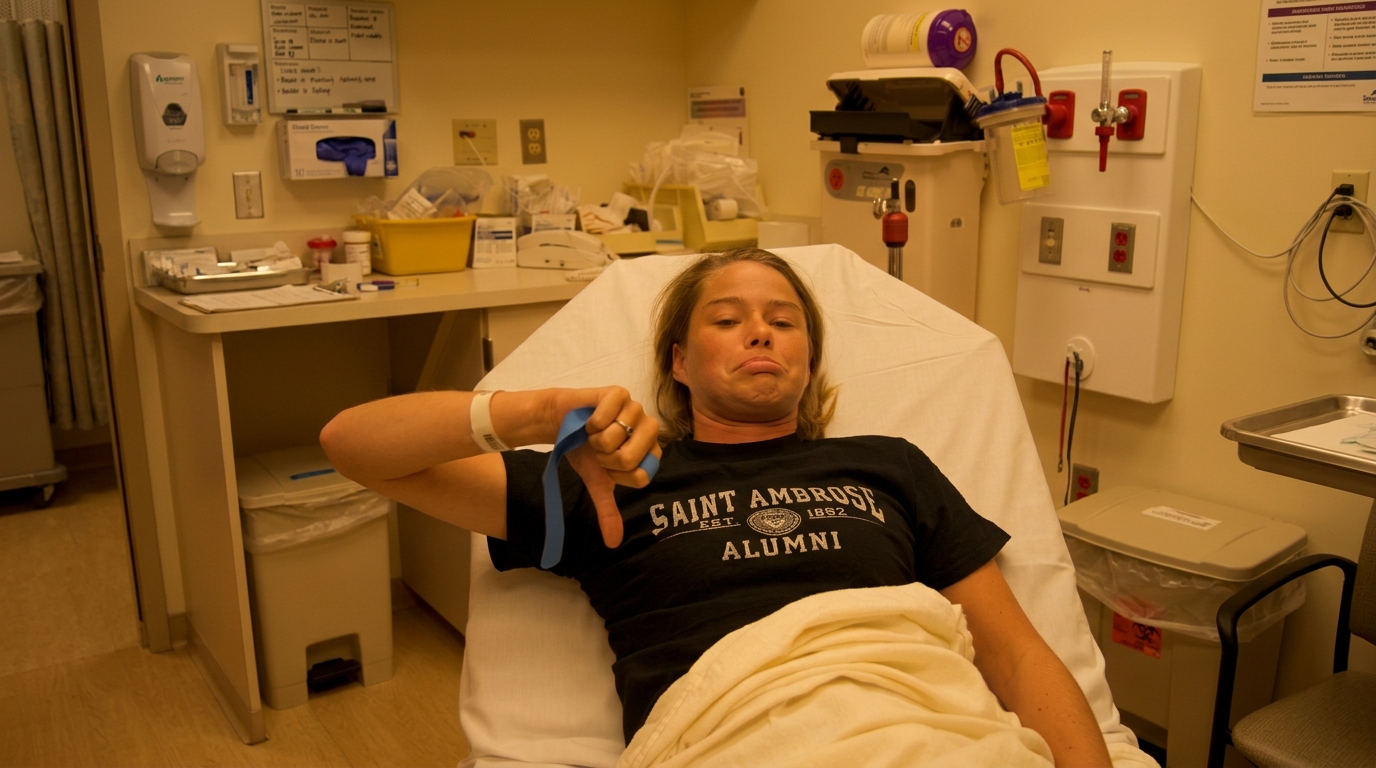
And that photograph from the emergency room still exists.
My friend Danielle took it after the detectives briefly left.
I was pale, exhausted, wearing that gray college T-shirt, lying under a hospital blanket with my wristband showing.
Danielle asked, “How are we doing?”
I gave her a thumbs-down.
She snapped the picture.
At the time, neither of us knew what the next forty-eight hours would uncover.
Now when I look at it, I don’t really see the bruises.
I think about how close I came to accepting the easiest explanation.
Mom was confused.
Eric was stressed.
Allison was defensive.
The money was probably somewhere.
Everything probably had an innocent reason.
Except sometimes it doesn’t.
Sometimes the uncomfortable question is the right question.
And sometimes the person making everyone uncomfortable isn’t the one causing the problem.
They’re simply the first one willing to point at it.
Thank you so much for reading this story.
If this story touched your heart, ❤️ Follow the page for more emotional real-life stories.

Leave a Reply