My 11-Year-Old Son Was Hit Outside His School — Then He Whispered the Name of the Driver
“Mom, lock the door before he comes back,” my eleven-year-old son whispered from his hospital bed, and for a few seconds I honestly thought the medication was making him confused.
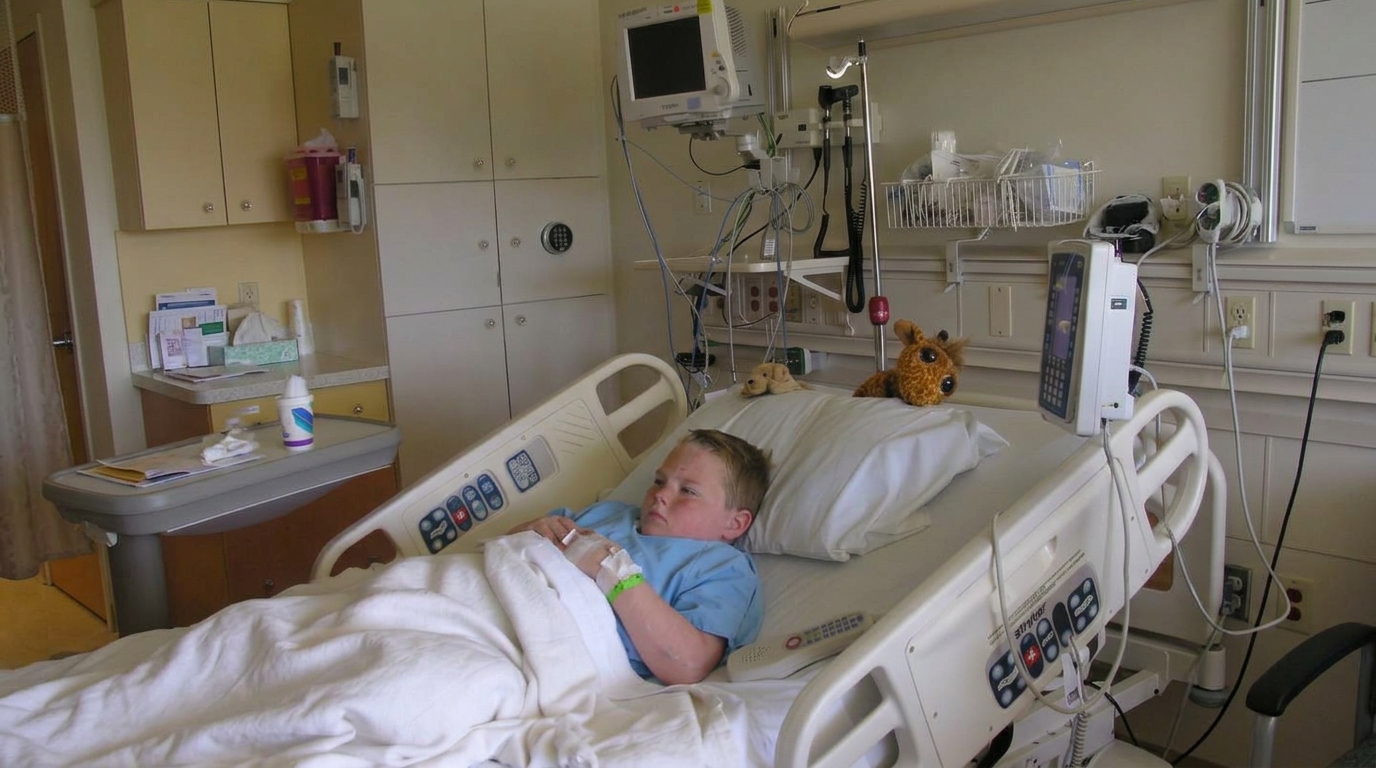
Micah looked tiny under the white blankets.
There were wires running from his chest to the monitor beside him, tape around the IV in his left hand, and a green hospital band around his wrist. Someone had placed two stuffed animals near his pillow. One was a giraffe with enormous plastic eyes that a nurse had found in the pediatric supply room.
Normally Micah would have made a joke about it.
That afternoon he wasn’t joking about anything.
He grabbed my wrist.
Not hard.
Just enough to make sure I was listening.
“Please,” he said.
“Who are you talking about?”
He looked toward the doorway.
“Mom. Close it.”
I stood up and pushed the hospital door almost shut, leaving only the small gap the nurses had asked us to keep.
It had been less than four hours since somebody had hit my son with a car outside his middle school in Worcester, Massachusetts, and driven away.
That was everything I knew.
Or at least everything I thought I knew.
I had been at work when the school secretary called.
There are sentences you hear once and remember for the rest of your life.
“Your son has been injured.”
“An ambulance is here.”
“You need to come immediately.”
I don’t remember hanging up.
I don’t remember taking my purse.
I barely remember driving.
By the time I reached the school, the ambulance had already left.
There were police cars blocking one side of the pickup lane. A bicycle was lying crooked near the curb. One wheel was bent almost completely sideways.
Micah’s trumpet case was on the sidewalk.
His backpack was open several yards away.
One of his sneakers was sitting alone beside a storm drain.
That sneaker bothered me more than anything.
It looked so ordinary.
Black with a white stripe.
I had yelled at him that morning because he had left both shoes in the kitchen again.
Now there was one sitting in the road while a police officer asked me whether Micah had enemies.
He was eleven.
“Enemies?”
The officer softened his voice.
“Any older kids bothering him? Anyone who might have had a problem with him?”
“No.”
“Anyone who would have been picking him up today besides you?”
“No.”
“His father?”
“His father lives in North Carolina.”
The officer wrote something down.
A crossing guard had seen part of what happened.
According to her, Micah had been standing near the edge of the faculty parking lot when a dark SUV came through much too fast.
She yelled.
Micah moved.
The SUV moved too.
That was the detail that bothered her.
She told police it hadn’t looked like the driver was simply losing control.
The car appeared to change direction.
Then it hit Micah near the hip, threw him onto the hood, and sent him rolling onto the pavement.
The SUV never stopped.
By some unbelievable piece of luck, Micah avoided the front tire.
A teacher ran into the road and stopped traffic.
Another teacher held Micah’s head still until the ambulance came.
At the hospital, doctors found a fractured wrist, two cracked ribs, a deep bruise across his hip and a concussion.
No internal bleeding.
No spinal injury.
No brain swelling.
Every doctor who came into that room used some version of the word lucky.
I hated that word by the end of the afternoon.
Lucky children didn’t end up with tire marks on their backpack.
But Micah was alive.
So I kept telling myself that was what mattered.
Then he woke properly.
And the first thing he asked me to do was lock the door.
I sat beside him again.
“Sweetheart, who are you afraid of?”
Micah stared at his blanket.
His mouth trembled once, but he pressed his lips together.
“I shouldn’t have taken the picture.”
“What picture?”
He didn’t answer.
“Micah.”
“I thought he was stealing Grandma’s stuff.”
My stomach tightened.
“Who?”
Micah’s eyes finally met mine.
And then he said the name I had absolutely no reason to expect.
“Uncle Travis.”
I stared at him.
My younger brother.
The man who had eaten Thanksgiving dinner at my table four months earlier.
The man who had helped Micah build his first bike ramp.
The man who had been calling me every twenty minutes since the accident asking for updates.
“He was driving the car, Mom.”
For several seconds, I couldn’t speak.
Not because I didn’t understand him.
Because I did.
Perfectly.
“Micah,” I said quietly, “are you sure?”
He nodded.
“Did you see him?”
“Yes.”
“Through the windshield?”
“He got out before.”
That made even less sense.
“Before what?”
Micah shifted and immediately winced.
I reached toward him, but he shook his head.
“Don’t touch my side.”
“Okay. Okay.”
I pressed the nurse button.
Then I asked the question that changed the entire shape of that afternoon.
“What happened before the car hit you?”
Micah looked toward the door again.
“He was at Grandma June’s house.”
My mother lived three blocks from Micah’s school.
She was seventy-four and stubbornly independent despite arthritis in both knees. After my father died, Travis and I had tried convincing her to move into something smaller.
She refused.
Her answer was always the same.
“Your father paid that mortgage for thirty-two years. I’m leaving that house feet first.”
So we stopped asking.
Micah sometimes walked there after school if I was running late.
That day, apparently, he’d decided to cut through her street because he wanted one of the frozen lemonade cups she kept in the garage freezer.
“Grandma wasn’t home,” he said.
I knew that.
Mom had a physical therapy appointment that afternoon.
“I saw Uncle Travis’s truck—”
“SUV?”
“Yeah. The black one.”
Travis drove a black Ford Explorer.
My mind immediately tried to defend him.
There were thousands of black SUVs.
Maybe Micah was confused.
Maybe the concussion—
Then Micah continued.
“He was carrying Grandma’s blue box.”
I knew exactly which box he meant.
My father had kept important documents in an old blue metal cash box.
After Dad died, Mom used it for bank papers, jewelry and emergency cash.
I leaned closer.
“How do you know?”
“Because the bottom was broken.”
I stopped.
The latch on that box had snapped the previous Christmas.
Mom had wrapped a brown elastic strap around it because she refused to buy a new one.
Micah knew that.
Most strangers wouldn’t.
“What did Travis say?”
“He didn’t see me at first.”
Micah swallowed.
“I took a picture because I thought maybe Grandma told him to get it. But then he came out again with her little jewelry bag.”
“What jewelry bag?”
“The red one.”
I knew that one too.
Mom kept my grandmother’s jewelry in a red velvet pouch.
Not expensive pieces, mostly.
A wedding ring.
A gold locket.
A thin bracelet.
Family things.
“And then he saw you?”
Micah nodded.
“He yelled my name.”
“What did you do?”
“I ran.”
I didn’t like imagining this next part.
I could see it too clearly anyway.
My son running down the sidewalk with his backpack bouncing behind him.
My brother shouting after him.
“I got on my bike,” Micah said. “He said, ‘Come here. You don’t understand.’”
“Did he touch you?”
“No.”
“Did he threaten you?”
Micah hesitated.
“Not then.”
Not then.
Two words I never wanted to hear.
“What happened?”
“He got in his car.”
Micah had been riding toward school because there were still teachers there and he thought Travis wouldn’t follow him into the parking lot.
But Travis did.
Micah said the Explorer pulled beside him once.
The passenger window came down.
Travis shouted for him to stop.
Micah kept riding.
Then Travis yelled something else.
“Give me the phone.”
Micah had the picture on his phone.
The picture of Travis carrying their grandmother’s blue metal box.
“I told him no.”
My son looked embarrassed when he said it, as if refusing had been some kind of mistake.
“Then he went around me.”
“What do you mean around you?”
“He drove ahead and stopped.”
Travis got out near the entrance to the school parking lot.
Micah turned his bicycle around.
Travis reached for the backpack.
Micah dropped the bike and ran.
A teacher’s voice somewhere across the lot called out, asking whether everything was okay.
That was when Travis got back into his SUV.
Micah thought it was over.
He grabbed his bicycle.
He started pushing it toward the school entrance.
Then he heard the engine.
“He came fast,” Micah whispered.
I could hear the monitor beside him speeding up.
I took his hand.
“You don’t have to tell me everything right now.”
“Yes, I do.”
“No. You don’t.”
“He said it was an accident.”
“When?”
“After.”
My head snapped up.
“You spoke to him after he hit you?”
Micah nodded.
For the first time, he started crying.
Not loudly.
That somehow made it worse.
“He stopped way down the street.”
I stared at him.
The crossing guard hadn’t seen that.
Neither had the teachers.
Travis apparently stopped beyond the corner.
Micah said he remembered lying on the pavement and hearing people running toward him.
Then his phone rang nearby.
It had fallen out of his hand.
The screen was cracked but still lit.
UNCLE TRAVIS.
“He called you?”
Micah nodded.
“What did he say?”
“I answered because I thought maybe he was calling an ambulance.”
My throat tightened.
“He said, ‘Tell them you didn’t see the car.’”
I couldn’t believe I was hearing this.
“He said that?”
“He said I rode out without looking and he couldn’t stop.”
“Micah…”
“Then he said if Grandma found out, she’d lose her house.”
That sentence confused me.
“What does Grandma’s house have to do with it?”
“I don’t know.”
The nurse came in then.
Micah’s heart rate had climbed, and she could see immediately that something was wrong.
I told her I needed the police officer back.
“Now.”
She looked at my face and didn’t ask why.
Within fifteen minutes, a detective named Ortiz was standing beside Micah’s bed.
I wanted to call Travis.
I wanted to scream at him.
Detective Ortiz told me not to.
“Don’t warn him,” she said.
I hated those words too.
Warn him.
As though my brother had suddenly become somebody the police needed to catch.
Micah repeated the story.
Slower this time.
The detective asked simple questions.
What color was the vehicle?
Where was Travis standing?
Which direction did he drive?
What was he wearing?
Had Micah seen the license plate?
Micah knew the Explorer because he had ridden in it dozens of times.
Then Detective Ortiz asked about the photograph.
“Where’s your phone?”
Micah looked at me.
I didn’t know.
Police hadn’t found it among the belongings brought from the scene.
That’s when Micah remembered something.
“Uncle Travis took it.”
The room went quiet.
“How?” Ortiz asked.
“After the ambulance came.”
That sounded impossible.
But then Micah explained.
He had been conscious on and off.
People were around him.
A teacher.
The crossing guard.
A paramedic.
And Travis.
He had come back.
On foot.
Apparently he’d parked somewhere nearby and returned pretending he’d only just heard what happened.
Nobody thought that was strange.
He was Micah’s uncle.
He knelt beside him.
Held his shoulder.
Asked if he was okay.
And while everyone was focused on getting Micah onto the stretcher, Travis picked up the phone.
Micah saw him do it.
“He put it in his coat.”
I felt sick.
I remembered Travis calling me while I was driving to the hospital.
“I’m on my way,” he’d said.
His voice had sounded shaken.
“Do they know who did it?”
At the time, I’d thought he was worried.
Now I wondered whether he had been checking what police knew.
Detective Ortiz stepped into the hallway.
Everything moved quickly after that.
Officers went to my mother’s house.
The back door hadn’t been forced.
Travis had a key.
Mom gave both of us one years earlier.
The blue metal box was gone.
The red jewelry pouch was gone.
So was an envelope containing almost $8,000 that my mother had withdrawn months earlier because she didn’t trust banks during “all that computer hacking nonsense,” as she put it.
But the money wasn’t the biggest discovery.
There were documents missing too.
Property papers.
Her Social Security information.
Bank statements.
A copy of her driver’s license.
Things that could cause a lot more damage than a stolen bracelet.
Then my mother told police something she hadn’t told me.
Travis had been asking her for money.
A lot of money.
His flooring business had collapsed during the previous year.
He owed taxes.
He owed a supplier.
He had borrowed from friends.
Mom had already given him $14,000.
She refused to give him more.
Three days before Micah was hit, Travis asked whether she would borrow against the house.
She said no.
He became angry.
Not violent.
But angry enough that she asked him to leave.
“Why didn’t you tell me?” I asked her over the phone.
“Because he’s your brother.”
As though that explained everything.
Maybe in families, sometimes it does.
Travis was arrested that evening.
Not at home.
Police found the Explorer behind a self-storage facility about nine miles away.
There was damage to the front passenger side.
They found my mother’s blue box inside a storage unit rented under Travis’s business name.
The money was mostly still there.
The jewelry too.
Micah’s phone was not.
For two days, Travis insisted the collision had been accidental.
He admitted taking the box, but claimed Mom had given him permission months earlier to access financial documents.
She hadn’t.
Then the school security footage came in.
The cameras didn’t capture the initial impact clearly because a maintenance truck blocked part of the view.
But one camera caught the Explorer entering the lot.
Another caught Micah running.
And then there was a third camera.
That one changed the case.
It showed Travis’s Explorer accelerating after Micah turned toward the sidewalk.
It wasn’t perfect footage.
But it showed enough.
The steering angle changed.
The SUV followed him.
He didn’t simply fail to brake.
He moved toward my son.
I watched that footage once.
Only once.
Detective Ortiz offered to pause it.
I told her not to.
On the screen, Micah looked impossibly small.
A boy with a backpack.
A child who still left half-empty cereal bowls in his bedroom and believed socks became clean again if you wore them inside out.
And there was a two-ton vehicle moving toward him.
Driven by someone who had held him as a baby.
Someone whose birthday cards were still hanging on our refrigerator.
The prosecutors eventually charged Travis with several offenses, including assault with a dangerous weapon, leaving the scene of an accident causing serious injury, larceny and witness intimidation.
The legal process lasted much longer than the hospital stay.
That surprised me.
Micah came home after five days.
The court case followed us for nearly a year.
There were hearings.
Delays.
Lawyers.
Family arguments.
Relatives who suddenly became experts despite knowing almost nothing.
One aunt told me I was “destroying the family.”
I asked her a question.
“If somebody who wasn’t related to us drove a car at Micah, would you say the same thing?”
She didn’t answer.
Another relative said Travis had been desperate.
As though desperation explained aiming a vehicle at a child.
I understood that my brother was drowning financially.
I understood that people can panic.
I understood that shame makes people do ugly things.
I even understood why he stole.
I will never understand why he chased an eleven-year-old.
Micah struggled more than I expected after coming home.
His bones healed.
His fear didn’t.
For almost two months, he wouldn’t ride his bike.
Black SUVs made him nervous.
If someone knocked unexpectedly, he looked at me before answering.
The strangest thing was that he kept asking about Travis.
Not because he wanted to see him.
Because he couldn’t fit what happened into the version of his uncle he’d known.
“Was he always bad?” Micah asked me one night.
I thought about it.
“No.”
“Then how did he do that?”
I didn’t have a neat answer.
I still don’t.
People want monsters to be monsters every day of their lives.
That’s easier.
But Travis had taken Micah fishing.
He had dressed as Santa one Christmas because my dad was sick.
He once drove six hours through snow to help me when my car broke down in Vermont.
Those things were also true.
And he drove a car at my son.
That was true too.
Eventually Travis accepted a plea agreement.
I won’t pretend that moment gave me peace.
It didn’t.
When he stood in court and apologized, I felt almost nothing.
Maybe I’d used up every emotion I had during the previous months.
He said he had never intended to seriously hurt Micah.
That sentence bothered me more than anything else he said.
Because it meant he still believed there was some acceptable amount of fear or injury he had intended.
Micah didn’t attend the sentencing.
That was his choice.
Instead, he wrote a letter.
He asked me not to read it.
So I didn’t.
His victim advocate read it aloud in court.
There was one part I remember.
“You were my favorite uncle. That is why this hurts more. I don’t hate you. I just don’t want to be scared of somebody I’m supposed to love.”
Travis lowered his head.
For the first time during the entire case, I saw him cry.
I wish I could say that fixed something.
It didn’t.
Some things shouldn’t be repaired quickly.
Maybe some things shouldn’t be repaired at all.
My mother eventually sold her house.
Not because Travis had forced her to.
Because after everything happened, she said the place didn’t feel peaceful anymore.
She moved into a small condo near us with a balcony overlooking a playground.
She complained about the homeowners association almost immediately, which was how I knew she was doing fine.
Micah recovered too.
Slowly.
The following spring, he asked me to take his bicycle out of the garage.
I tried not to make a big deal about it.
Parents learn when their children are watching to see whether we’re scared.
So I handed him his helmet.
“Want me to come?”
He thought about it.
“No.”
Then he changed his mind.
“Actually, maybe just around the block.”
So we rode together.
I hadn’t been on a bike in years.
My knees hated every second.
Micah laughed at me.
It was one of the best sounds I’d heard in months.
We passed the end of Grandma June’s old street.
Micah slowed.
For a moment, I thought he wanted to turn around.
Instead, he kept going.
I didn’t say anything.
Neither did he.
A few weeks later, the school replaced the damaged bike rack near the parking lot.
The crossing guard who had first seen the SUV still worked there.
Her name was Mrs. Alvarez.
Micah made her a thank-you card because she had been the first person to scream for someone to call 911.
He drew a terrible picture of her wearing a superhero cape.
She taped it inside the little booth where crossing guards kept their reflective vests.
It stayed there all year.
Today, Micah is taller than he was in that hospital bed.
His wrist sometimes aches when the weather turns cold.
He has a small scar near his elbow.
He still doesn’t like anyone grabbing his backpack unexpectedly.
But he rides his bike again.
He plays trumpet badly and enthusiastically.
He argues about homework.
He forgets dishes in his room.
He complains that Grandma texts too many emojis.
Normal things.
Beautifully normal things.
As for Travis, I haven’t spoken to him directly since the courthouse.
He has written letters.
Some I opened.
Some I didn’t.
Micah has received two.
He read the first.
He returned the second unopened.
I didn’t force either decision.
That’s something this experience taught me.
Adults create damage children never asked for.
The least we can do afterward is stop deciding how they are supposed to feel about it.
People sometimes ask whether I miss my brother.
Yes.
That’s the uncomfortable truth.
I miss the brother I thought I had.
I miss the man who sat on my kitchen floor teaching Micah how to tie fishing knots.
I miss calling him when Mom was being impossible.
I miss family dinners before every conversation became divided into “before” and “after.”
But missing someone doesn’t mean giving them access to your life.
Forgiveness isn’t the same as trust.
And blood isn’t permission.
There is one object from that hospital room I kept.
The ridiculous stuffed giraffe.
Micah didn’t want it when we got home.
He said its eyes were creepy.
So I put it in a closet.
A year later, I found it while cleaning.
For a second I considered throwing it away.
Instead, I gave it to my mother.
It sits on a shelf in her condo now.
Sometimes when I see it, I’m back in that hospital room.
The monitor.
The white blanket.
My son’s hand around my wrist.
“Lock the door.”
I used to think that moment was about fear.
Now I think it was about trust.
Micah knew something terrible had happened.
He knew telling me might tear apart our family.
He knew his uncle had already tried to frighten him into silence.
And he told me anyway.
That became the part I chose to remember most.
Not the car.
Not the courtroom.
Not even my brother.
My son told the truth when telling it was difficult.
And when he asked me to close that hospital door, I did.
Then, when he was ready, we opened it again.
Thank you so much for reading this story.
If this story touched your heart, ❤️ Follow the page for more emotional real-life stories.

Leave a Reply