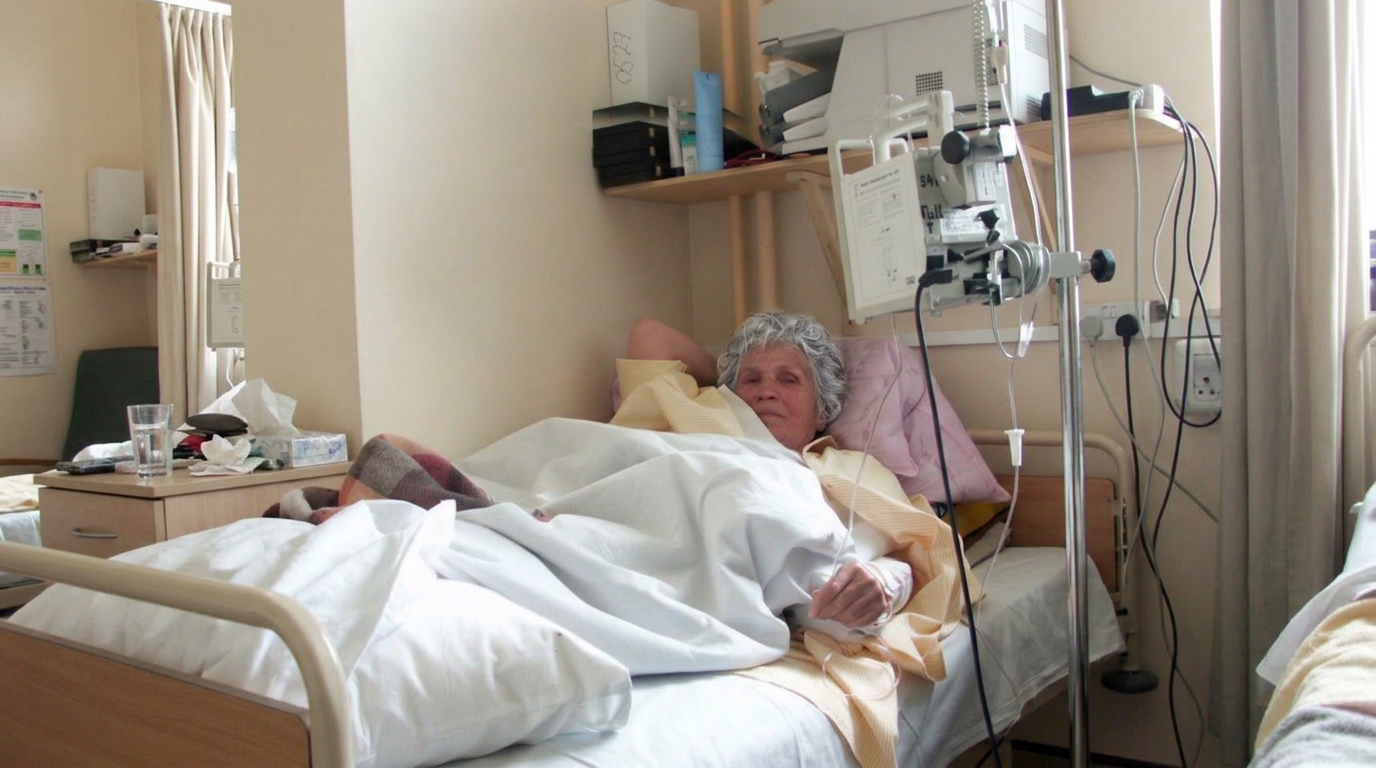
My Mother Said She Fell in the Kitchen—Then a Nurse Quietly Asked Me Who Had Been in the House With Her

The first thing my mother said when I walked into her hospital room wasn’t “hello” or “I’m glad you came”—she looked straight at me, grabbed my wrist with surprising strength, and whispered, “Whatever your brother tells you, don’t believe him.”
For a second, I thought the pain medication had confused her.
My mother, Evelyn, was seventy-four and stubborn enough to argue with a smoke detector. She lived alone in the same two-story brick house outside Pittsburgh where my brother and I had grown up. She still drove herself to church, still planted tomatoes every spring, and still refused to hire anyone to clean the gutters because, according to her, “People charge eighty dollars to lean a ladder against a wall.”
I had spent years telling her that seventy-four was an age when she was officially allowed to stop climbing ladders.
She ignored me.
That was why the nurse’s phone call earlier that afternoon had scared me.
“Your mother is stable,” the woman had said. “She had a fall at home.”
A fall.
That was all I got.
Mom had apparently told the emergency room staff that she had slipped while carrying laundry downstairs.
By the time I arrived, she had an IV in one hand, a bandage around the other wrist, and enough blankets piled over her that I could barely see the yellow hospital gown underneath.
There was a dark bruise along her cheek.
Another near her collarbone.
And when she reached for me, I noticed several marks around her wrist that didn’t look like anything a laundry basket would cause.
“Mom,” I said quietly, pulling the plastic chair closer. “What happened?”
“I told them.”
“You fell.”
“Yes.”
“On the stairs?”
She looked toward the door.
“Yes.”
“Then why did you just tell me not to believe Aaron?”
Her lips tightened.
Aaron was my younger brother.
Forty-three years old, divorced twice, permanently between jobs, and somehow always two months away from “getting everything back together.”
For the previous year, he had been living with Mom.
That arrangement was supposed to last six weeks.
It had lasted fourteen months.
“Aaron is upset,” she said.
“That doesn’t answer me.”
“Dana, please.”
I knew that tone.
It was the tone she used when Dad was alive and they had argued in the kitchen but she didn’t want us asking questions.
It was the tone she used when she had been diagnosed with high blood pressure and didn’t tell me for three months.
The tone meant there was something behind the answer.
I lowered my voice.
“Did Aaron hurt you?”
Her eyes immediately filled with tears.
But she shook her head.
Too fast.
“No.”
“Mom.”
“No. He didn’t.”
I stared at her.
Then I asked the question I probably should have asked first.
“Was Aaron home when you fell?”
Mom said nothing.
A cart rattled past in the hallway.
Somewhere down the corridor, a machine started beeping.
I waited.
Finally she whispered, “He was there.”
“What happened?”
“He was upset.”
“About what?”
Another silence.
Then she looked directly at me.
“He wanted the house.”
I didn’t understand.
“What do you mean, he wanted the house?”
“He wanted me to sign something.”
“What?”
She swallowed.
“A paper his friend brought over.”
“What paper?”
Her eyes dropped toward the blanket.
“I don’t know exactly.”
“You signed something you didn’t understand?”
“I didn’t sign it.”
I leaned back.
That was the first moment I realized this wasn’t about a bad argument.
It wasn’t about my brother losing his temper over money.
Something bigger had happened in that house.
“What did Aaron want you to sign?”
Mom looked toward the hallway one more time.
Then she said, barely above a whisper:
“He wanted me to give him the house.”
I stared at her.
“The whole house?”
She nodded.
“For what?”
“He said it would make things easier.”
“For who?”
No answer.
“Aaron?”
Her mouth trembled.
“He said if the house was in his name, he could refinance it.”
My stomach tightened.
My mother’s house was paid off.
My father had spent nearly thirty years making payments on it before he died.
There was no mortgage.
No debt.
Nothing to refinance.
Unless Aaron wanted to borrow against it.
“How much money does he owe?”
Mom turned her face away.
That answer told me almost everything.
“How much?”
“I don’t know.”
“You do.”
“I don’t know exactly.”
“Mom.”
She closed her eyes.
“Maybe sixty.”
“Sixty what?”
She didn’t answer.
“Sixty thousand?”
She nodded.
I stood up so quickly the chair scraped across the floor.
“Sixty thousand dollars?”
“Keep your voice down.”
“To who?”
“I don’t know.”
That was the first thing I actually believed.
My brother had always been secretive about money.
He had owned a roofing company for a few years. Then a used car lot with a friend. Then something involving online sports memorabilia that he claimed was “basically guaranteed profit.”
Every business ended the same way.
Aaron stopped answering questions.
Bills appeared.
Someone got angry.
Mom gave him money.
I had stopped lending him anything years earlier.
Mom never did.
“How much have you already given him?” I asked.
She rubbed her thumb against the edge of the blanket.
“Some.”
“How much is some?”
She sighed.
“Dana.”
“How much?”
“Twenty-eight thousand.”
I actually laughed.
Not because it was funny.
Because my brain couldn’t find another response.
“You gave Aaron twenty-eight thousand dollars?”
“Not all at once.”
“That somehow makes it worse.”
“He was trying to get back on his feet.”
“Mom, he’s forty-three.”
“He’s my son.”
“And I’m your daughter. Does that mean I get half your retirement account whenever I make a bad decision?”
“Don’t be cruel.”
I immediately regretted it.
She was lying in a hospital bed with bruises on her face.
I sat down again.
“I’m sorry.”
She looked tired.
Older than seventy-four.
For the first time in my life, my mother looked small.
“What happened today?” I asked.
She stared at the ceiling.
“Aaron brought a man over.”
“What man?”
“His name was Vince or Vincent. I’d seen him once before.”
“A lawyer?”
“I don’t think so.”
“What did he say?”
“They had papers.”
“And?”
“They told me I could sign the house over temporarily.”
I shook my head.
“There is no such thing as temporarily giving someone your house.”
“I know that now.”
“You knew it then.”
She looked at me.
That hurt because she knew I was right.
“What happened when you refused?”
She picked at a loose thread on the blanket.
“Aaron got angry.”
“How angry?”
“He started yelling.”
“And?”
“He knocked over one of the dining room chairs.”
“And?”
“He said I had ruined his life.”
I waited.
“And?”
“He said Dad always thought he was a failure.”
I remembered that argument.
Dad and Aaron had fought constantly during the last few years of Dad’s life.
Dad believed Aaron expected the family to rescue him from every bad decision.
Aaron believed Dad never respected him.
They were both partly right.
“He started crying,” Mom continued. “Then yelling again.”
I could picture it.
Aaron had always moved quickly between anger and self-pity.
“What happened to your face?”
Mom went quiet.
“Mom.”
She touched the bruise lightly.
“I hit the wall.”
“How?”
“He grabbed my arm.”
The words were almost inaudible.
I said nothing.
“He didn’t mean to hurt me.”
There it was.
The sentence families use when something has already gone too far.
“He grabbed your arm.”
“Yes.”
“And then?”
“I tried to get away.”
“And?”
“He wouldn’t let go.”
I stared at the bruises around her wrist.
“He pushed me.”
Her voice broke.
I closed my eyes.
For one second I saw Aaron at twelve years old, sitting on our back porch with muddy sneakers, crying because Dad had yelled at him for breaking a neighbor’s window.
Then I saw the man he had become.
“He pushed you down the stairs?”
“No.”
She said it quickly.
“He pushed me against the wall. I lost my balance. I fell near the bottom step.”
“That’s still because he pushed you.”
“He didn’t push me down the stairs.”
“Mom, stop protecting the wording.”
She started crying.
Not loudly.
That somehow made it worse.
“I don’t want him arrested.”
I leaned forward.
“You could have broken your neck.”
“He needs help.”
“So do you.”
“He’s my son.”
“And you’re his mother. That doesn’t make you a punching bag.”
She flinched at the phrase.
I regretted that too.
But I wasn’t taking it back.
We sat there for several minutes.
Then she said something that surprised me.
“I already called the police.”
I stared at her.
“You did?”
She nodded.
“From the ambulance.”
That didn’t fit with everything else she had been saying.
“What did you tell them?”
“The truth.”
“All of it?”
“Yes.”
“Then why are you telling me you don’t want him arrested?”
“Because wanting something and knowing what has to happen aren’t always the same thing.”
That was the most like my mother she had sounded all day.
I reached for her hand.
She squeezed mine.
The police arrived about twenty minutes later.
A patrol officer and a detective came into the room.
Mom repeated her statement.
She told them about the papers.
The argument.
The money.
The push.
Then the detective asked a question neither of us expected.
“Mrs. Lawson, did your son have access to your bank accounts?”
Mom hesitated.
“Yes.”
I turned toward her.
“What?”
“He helped me set up online banking.”
The detective asked whether Aaron knew her passwords.
“I suppose he might.”
My irritation disappeared.
A different kind of fear replaced it.
The detective noticed.
“Mrs. Lawson, with your permission, I strongly recommend you contact your bank tonight.”
Mom nodded.
I was already reaching for my phone.
We discovered the first transfer less than ten minutes later.
Nine thousand dollars.
Then another.
Four thousand five hundred.
Then three smaller withdrawals.
All within six weeks.
Mom stared at the screen.
“I didn’t do those.”
I knew.
The total was just over nineteen thousand dollars.
On top of the twenty-eight thousand she had willingly given him.
My mother looked devastated.
Not angry.
Devastated.
“He stole from me.”
Nobody answered.
She said it again.
“He actually stole from me.”
That was the moment something changed.
Until then she had been explaining Aaron.
Excusing him.
Reducing every bad thing into something temporary.
A bad year.
A bad marriage.
A bad business partner.
A bad temper.
But there was no softer word for what was on that bank statement.
The detective asked Mom to forward screenshots.
Then he asked whether Aaron had a key to any safe, lockbox, or desk in the house.
Mom looked at me.
“The basement cabinet.”
“What’s in it?” I asked.
“Dad’s papers.”
“What papers?”
“House deed. Insurance. Tax records.”
The detective stood.
“Do you have somewhere else you can stay after discharge?”
“She’s staying with me,” I said before Mom could argue.
I lived outside Columbus.
She hated the idea of leaving Pennsylvania.
I didn’t care.
Not that night.
Aaron was arrested two days later.
The police found him at a motel less than ten miles from Mom’s house.
I wish I could say I felt relieved.
Mostly I felt sick.
He called me from the county jail the next morning.
I almost didn’t answer.
Then I did.
“Dana.”
His voice sounded tired.
“What?”
“You know Mom’s exaggerating.”
I laughed.
Same family reflex, apparently.
“I saw her.”
“I didn’t throw her down the stairs.”
“She never said you did.”
Silence.
That told me he already knew exactly how bad the truth sounded.
“She grabbed me first.”
“She’s seventy-four.”
“So that means she can’t grab somebody?”
“You stole nineteen thousand dollars.”
Another silence.
“That was money she owed me.”
“For what?”
“For years of helping her.”
I felt something in me finally harden.
“You lived in her house rent-free.”
“I took care of things.”
“You took care of her bank password.”
“Come on, Dana.”
“No.”
“What?”
“No. I’m not doing this.”
“Doing what?”
“The part where you explain every terrible thing until everyone else gets tired and calls it a misunderstanding.”
He said nothing.
I continued.
“You hurt Mom. You stole from her. You tried to take her house.”
“That house was going to be mine someday anyway.”
There it was.
Not shame.
Not denial.
Entitlement.
I hung up.
Mom stayed with me for almost seven weeks.
At first she hated it.
She criticized my coffee.
She reorganized my pantry.
She claimed my guest-room mattress was “too soft for a human spine.”
Then something unexpected happened.
She relaxed.
She stopped checking her phone every few minutes.
She stopped asking whether Aaron had called.
She slept through the night.
One afternoon I found her sitting on my back deck wrapped in an old cardigan, watching my neighbor’s kids chase each other through fallen leaves.
“You know what’s strange?” she said.
“What?”
“I didn’t realize how nervous I was in my own house.”
That sentence hurt more than anything she had said in the hospital.
“How long?”
She thought about it.
“Months.”
“Why didn’t you tell me?”
She smiled sadly.
“Because you would have told me the truth.”
I understood exactly what she meant.
Sometimes people don’t hide things because they don’t know what is happening.
They hide them because they already know what someone they trust will say.
Aaron eventually pleaded guilty to several charges after his attorney negotiated an agreement.
There were consequences.
Real ones.
Mom testified.
She cried afterward in the courthouse bathroom.
Then she washed her face, looked in the mirror, and said, “I can love him and still stop him.”
I wrote those words down later.
I didn’t want to forget them.
She sold the house the following spring.
That surprised everyone.
Especially Aaron.
He had spent years assuming that house was his future.
Mom decided it wasn’t going to be anybody’s inheritance.
She bought a smaller one-story condo near my aunt outside Harrisburg.
No stairs.
No gutters she could climb onto.
No spare bedroom for adult sons who needed “six weeks.”
When I helped her move, we found one of Dad’s old brass keys in the kitchen junk drawer.
Mom held it up.
“That’s the back-door key.”
“To the old house?”
She nodded.
“You want it?”
I thought she might keep it.
Instead she dropped it into the trash.
“No.”
I looked at her.
“You sure?”
She closed the drawer.
“Yes.”
Then she walked outside and sat on the front step while the movers loaded the last box.
People sometimes ask me whether she has forgiven Aaron.
I don’t think forgiveness is as simple as people make it sound.
She loves him.
She sends him a birthday card.
She answers some of his letters.
She has not given him her new address.
Those things can all be true at the same time.
And Aaron?
He still thinks I turned her against him.
Maybe believing that is easier than admitting she finally stopped turning against herself.
The last time Mom and I talked about that hospital room, she said something I wasn’t expecting.
“I was more embarrassed than scared.”
“Why?”
“Because I knew better.”
I told her what I wish someone had told her much earlier.
Knowing better doesn’t always mean leaving sooner.
Sometimes people spend so much time hoping someone they love will become who they used to be that they stop noticing who that person has become.
Mom didn’t answer.
She just looked out the window.
After a minute, she said, “Well, I notice now.”
And that was enough.
Not a perfect ending.
Not the family fixed.
Not everyone hugging in a kitchen at Christmas.
Just my mother, safe in a home she chose herself, with her own bank account, her own keys, and no one standing over her asking for a signature.
For us, that was a beginning.
Thank you so much for reading this story.
If this story touched your heart, ❤️ Follow the page for more emotional real-life stories.

Leave a Reply