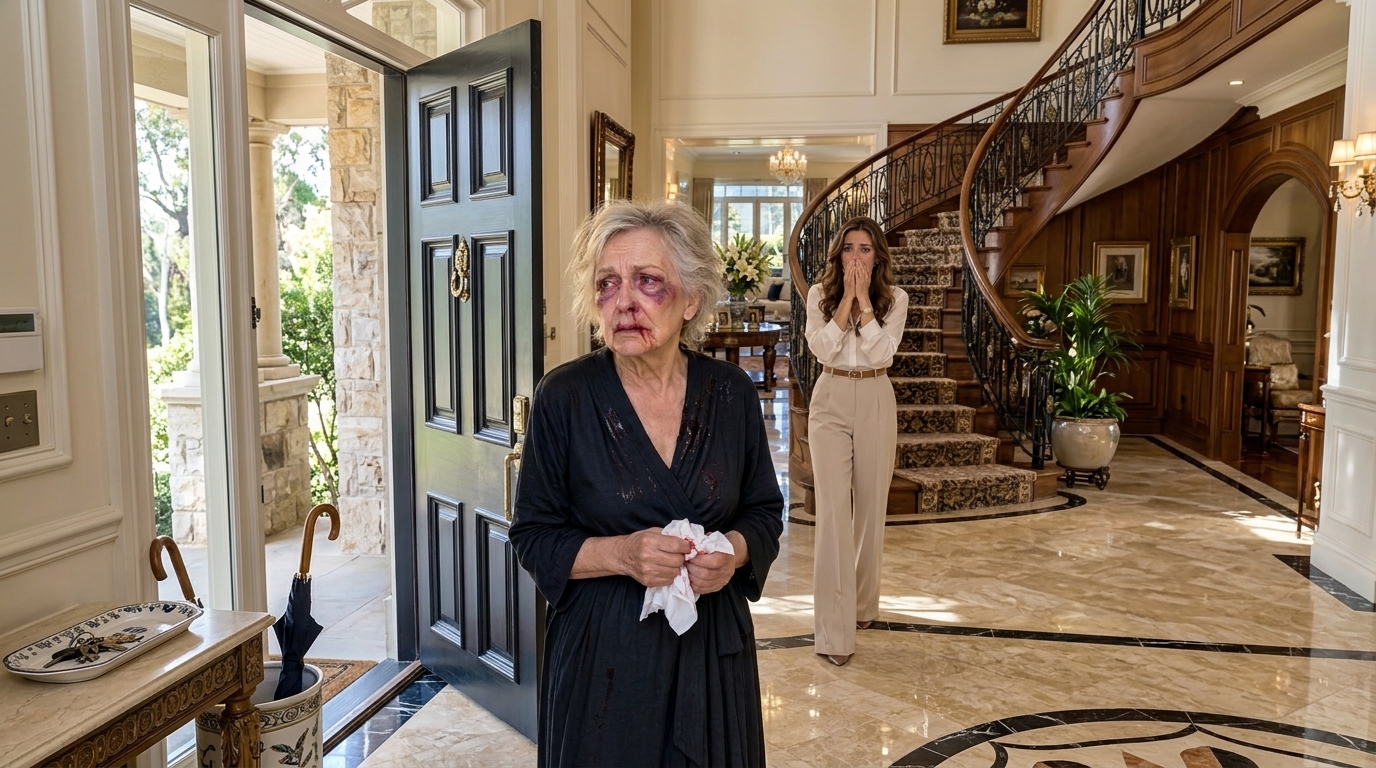
MY SON HAD BARELY BEEN BURIED WHEN MY DAUGHTER-IN-LAW SHOVED TWO SUITCASES INTO MY HANDS AND SNEERED, “THE $4 MILLION ESTATE IS MINE NOW. GET OUT!”

The words came so suddenly that, for several seconds, I honestly thought I had misunderstood her.
My only son had been buried less than two hours earlier.
I was still wearing the same black dress I had worn to his funeral. My shoes were muddy from the cemetery, my eyes were swollen from crying, and my hands were trembling so badly that I could barely hold my handbag.
Yet there I stood, inside the beautiful $4 million estate in Myers Park, Charlotte, North Carolina, listening to my daughter-in-law tell me that I was no longer welcome in the home where I had lived for eleven years.
And she wasn’t asking me to leave.
She was ordering me out.
Brielle stood near the front door with her arms folded. Beside her were two large suitcases, already packed with my clothes and personal belongings.
I stared at them.
Then I looked at her.
“What is this?” I whispered.
She glanced at her watch.
“Your things. I had someone pack them while we were at the cemetery.”
For a moment, I couldn’t breathe.
“You packed my belongings?”
“Yes, Theresa. I didn’t think you’d want to waste time doing it yourself.”
I looked around the house.
The polished marble floors. The enormous staircase. The crystal chandelier hanging above the entrance. The family photographs lining the hallway.
Every corner held a memory of my son, Warren.
I had watched him grow up. I had held him when he was sick, comforted him when his father died, celebrated his graduation, and cried with happiness when he bought his first home.
And now, after burying him, I was being treated like an unwanted stranger.
“Brielle, please,” I said quietly. “I just buried my son. I don’t have anywhere else to go tonight. Let me stay until tomorrow. I promise I won’t bother you.”
She gave a short, humorless laugh.
“Tomorrow? And then what? You’ll find another excuse to stay for a week? A month? A year?”
“I only need a little time.”
“Well, you don’t have it.”
She picked up the wine-colored folder she had been holding and tapped it against her palm.
“Warren left everything to me. The house, the money, the investments, the properties. Everything. The estate is worth approximately four million dollars, and it’s mine now.”
I stared at her.
“Everything?”
“That’s what I said.”
“But Warren would never—”
“Don’t start.”
Her voice became sharper.
“Your son was my husband. I was the person who shared his life. You were simply living here because he allowed you to.”
Those words hurt more than I expected.
Simply living here.
As if the eleven years I had spent caring for my son meant nothing.
As if I had been a burden he had generously tolerated.
I looked down at the two suitcases.
“Where am I supposed to go?”
She shrugged.
“There’s a cabin in the mountains. Warren mentioned it to you, didn’t he? You can stay there.”
I knew the cabin she meant.
It was an old wooden property in the Blue Ridge Mountains. Warren had bought it years earlier because he liked the surrounding forest. But the place had been neglected for a long time.
The roof leaked. The windows were damaged. There was no proper heating, and I wasn’t even sure the electricity still worked.
“You want me to go there tonight?”
“Unless you have somewhere better.”
“Brielle, it’s raining.”
“Then take an umbrella.”
I looked at her for a long moment.
I had spent eleven years trying to earn this woman’s acceptance.
Eleven years swallowing insults, ignoring her coldness, and convincing myself that if I remained patient, she would eventually see me as family.
But standing there, with my son’s funeral flowers still resting in the hallway, I finally understood something.
She had never considered me family.
I was only someone she tolerated because Warren was alive.
And now Warren was gone.
For eleven years, I had lived in that house.
When Warren first invited me to move in, I was sixty-one and had recently lost my husband. My son told me he didn’t want me living alone.
“Mom, there’s plenty of room,” he had said. “You raised me. Let me take care of you for a change.”
I remembered how happy those words had made me.
I never imagined that accepting his invitation would eventually become something I would be made to feel ashamed of.
I did my best to stay out of Brielle’s way.
Even though the house had a housekeeper, I cooked Warren’s favorite meals whenever I could. I made his morning coffee, watered the small garden he and I had planted together, and kept his childhood photographs in my room.
I also helped whenever he wasn’t feeling well.
Sometimes he worked late and came home exhausted. I would warm his dinner and sit with him while he told me about his business.
Those little moments meant everything to me.
But Brielle never liked seeing us together.
Whenever she hosted business associates, she would politely ask me to remain upstairs.
“Theresa, we’re having important people over tonight. It would be better if you ate in your room.”
I used to smile and agree.
When I asked why, she would say something like:
“Business people don’t always know how to talk to older relatives. It might become uncomfortable.”
I knew what she really meant.
She didn’t want her guests seeing me.
One Christmas, I spent nearly two days preparing a meal for the family. I made Warren’s favorite roast, baked apple pie, prepared vegetables, and even decorated the dining room.
When everyone arrived, Brielle asked me to eat in the kitchen.
I remember standing there with a serving spoon in my hand.
“But I prepared the dinner,” I said.
She smiled without warmth.
“And we appreciate that. But tonight is about Warren’s business partners.”
Warren heard her.
He looked uncomfortable, but he said nothing.
Later that evening, he came into the kitchen and squeezed my shoulder.
“Please don’t take it personally, Mom. You know how Brielle gets.”
I nodded.
I always nodded.
I thought I was protecting my relationship with my son by avoiding arguments with his wife.
I never understood that every time I stayed silent, I was teaching them both that my feelings didn’t matter.
And now, standing in the entrance of that house, I remembered every single occasion.
I remembered the Christmas dinner.
The birthdays I had spent alone upstairs.
The conversations I had overheard through closed doors.
And all the times Warren had looked down instead of standing up for me.
For the first time, I wondered whether his silence had been protection or simply cowardice.
“Brielle,” I said, bringing myself back to the present, “at least let me take Warren’s photograph from the hallway.”
She immediately stepped in front of me.
“Which photograph?”
“The one on the small table near the staircase.”
“No.”
I blinked.
“What?”
“That photograph stays here.”
“It’s a picture of my son.”
“And everything inside this house belongs to the estate.”
I stared at her.
She actually wanted to keep me from taking a photograph of my own child.
I felt something inside me break.
I didn’t shout.
I didn’t cry.
I simply looked at her and said:
“Show me the will.”
For the first time that afternoon, Brielle hesitated.
It was only a second, perhaps less, but I noticed it.
Then she lifted her chin.
“My attorney will handle everything.”
“Then let me speak with him.”
“You don’t need to speak with anyone.”
“Why not?”
“Because you have no legal reason to interfere.”
I looked at the folder in her hands.
“Then why are you in such a hurry to get me out?”
Her expression changed.
“Twenty minutes, Theresa. That’s all I’m giving you.”
A driver was waiting outside.
He loaded my two suitcases into the back of a black SUV and opened the passenger door.
I turned around one last time.
The house stood exactly as it always had. Warm lights glowed through the windows, and the flowers I had arranged near the entrance were still there.
But I was no longer welcome.
I climbed into the vehicle without saying another word.
As we drove away, I watched the estate disappear behind us.
I had no idea where I would sleep that night.
I had no idea what would happen to my belongings.
And I had absolutely no idea that the journey to that abandoned mountain cabin would change everything.
The driver was an older man named Samuel. He had worked for Warren for several years.
He kept glancing at me through the rearview mirror.
Finally, he spoke.
“Mrs. Whitlock, I’m very sorry.”
I looked out the window.
“Thank you, Samuel.”
He hesitated.
“Your son was a good man.”
My eyes filled again.
“He was my whole world.”
Samuel nodded and continued driving.
The journey took nearly three hours. The rain became heavier as we left the city and entered the winding mountain roads.
Eventually, the SUV turned onto a narrow gravel path.
I looked outside.
There were trees everywhere.
No neighboring houses.
No streetlights.
No signs of life.
Then I saw it.
The cabin.
It looked worse than I remembered.
The wooden exterior was weathered, one window was broken, and dark water stains covered part of the roof.
Samuel stopped the vehicle.
He unloaded my suitcases and placed them beside the front steps.
I looked at the cabin.
“Are you sure this is the right place?”
He didn’t answer immediately.
Then he reached into his jacket and pulled out a small white envelope.
“Your son gave me this several months ago.”
I turned toward him.
“What?”
“He told me that if anything happened to him and you ever came here alone, I was supposed to give it to you.”
My heart began pounding.
“Why didn’t you give it to me earlier?”
“I was waiting for the right moment. I didn’t know whether I should say anything while the family was together.”
I took the envelope with trembling fingers.
On the front, in familiar handwriting, were two words.
FOR MOM.
I recognized Warren’s handwriting immediately.
I opened it.
Inside was a small brass key and a folded piece of paper.
I unfolded the note.
“Mom, clean the altar first. Don’t sign anything Brielle brings you.”
I read it once.
Then again.
And a third time.
My hands began shaking.
Why would Warren write something like that?
What did he know about Brielle?
And why had he specifically warned me not to sign anything?
I looked up to ask Samuel another question, but he was already getting back into the driver’s seat.
“Please take care of yourself, Mrs. Whitlock.”
Then he drove away.
I stood alone in the rain.
Two suitcases at my feet.
A mysterious key in my hand.
And a warning from the son I had buried only hours earlier.
That night, I barely slept.
The cabin was freezing. I found an old blanket inside a cupboard and wrapped it around my shoulders.
There was no electricity, and the silence outside was almost frightening.
Every time the wind moved through the trees, the damaged window rattled.
I sat on the floor and held Warren’s photograph against my chest.
I cried until my throat hurt.
“Why didn’t you tell me, sweetheart?” I whispered. “What were you trying to protect me from?”
There was no answer.
Only the sound of rain hitting the roof.
But as the night passed, my grief slowly began to mix with something else.
Suspicion.
The next morning, I woke up determined to understand the note.
I found an old broom and began cleaning.
Not because I believed everything would suddenly become better.
Not because I expected someone to come rescue me.
But because I refused to spend the rest of my life sitting in a cold cabin waiting for people who had already decided I was disposable.
I cleaned the kitchen first.
Then the living room.
I moved old boxes, swept the dust from the corners, and opened the curtains to let in the weak morning light.
Eventually, I reached the darkest corner of the room.
There it was.
A small wooden altar.
It was covered in dust and cobwebs.
I immediately recognized it.
Warren had brought it to the cabin years earlier. He used to place small family photographs on it and light a candle whenever he visited.
I remembered him telling me:
“One day, Mom, I’m going to restore this place. You’ll love it here.”
I had laughed.
“Why would I want to live in the middle of nowhere?”
He smiled.
“Sometimes the quietest places are the safest.”
At the time, I thought he was joking.
Now those words came back to me.
I wiped the altar with my sleeve.
As I cleaned the back, I noticed a small carving in the wood.
A letter.
T.
My initial.
I touched it gently.
Then I placed Warren’s photograph on top.
Beside the altar stood an old iron candlestick. I picked it up to move it, but it was heavier than I expected.
It slipped from my hand.
CLANG!
The sound echoed through the cabin.
I froze.
Something about the sound was strange.
It hadn’t sounded like iron hitting ordinary wooden flooring.
It had sounded hollow.
I knelt and moved the remaining dust aside.
There was a thin line between two floorboards.
A seam.
I ran my fingers over it.
The line was too straight to be accidental.
My heart started racing.
I grabbed the candlestick and carefully pushed its narrow edge into the gap.
After several attempts, one of the boards lifted slightly.
I pulled it upward.
And beneath the floor was a small metal box wrapped in an old piece of canvas.
For several seconds, I simply stared at it.
Then I remembered the key.
I rushed to my handbag and pulled out the little brass key Samuel had given me.
It fit perfectly.
My fingers trembled as I turned it.
CLICK.
The lock opened.
Inside were bank statements, business contracts, printed emails, invoices, photographs, and several sealed envelopes.
There were also copies of six financial transfers.
But the most important thing was a handwritten letter resting on top.
It had my name on it.
I opened it.
“Mom,
If you’re reading this, it means Brielle did exactly what I feared she might do.
Before you believe she inherited everything, go see the notary, Eleanor Hartwell.
And please, don’t go back to the house alone.
There are things you need to understand before you sign anything.
I love you.
Warren.”
My eyes filled with tears.
I pressed the letter against my chest.
Then I noticed another photograph.
It showed Warren standing outside a notary’s office in Charlotte.
The date written on the back was three months before his death.
Underneath it were five words.
“The copy isn’t worth more than the original, but it will tell you where to look.”
I was still trying to understand what he meant when I heard something outside.
An engine.
A truck.
It was approaching the cabin.
I quickly closed the metal box.
Then I heard a car door slam.
Someone was coming.
And when I opened the front door, my blood ran cold.
Brielle was standing on the porch.
Beside her was her brother, Clay.
And behind them stood a man in an expensive gray suit.
The man smiled politely.
“Mrs. Theresa Whitlock? I’m attorney Paxton. We need to discuss a few documents.”
I knew immediately that the warning in Warren’s letter had been for this exact moment.
And what they wanted me to sign would change everything.
PART 2 — THE DOCUMENT MY DAUGHTER-IN-LAW WANTED ME TO SIGN
I didn’t invite them inside.
I simply stood in the doorway, holding the edge of the door with one hand.
Brielle looked past me into the cabin.
Her eyes moved over the broken window, the dusty furniture, and the old wooden altar.
Then she smiled.
“I see you’ve settled in.”
I looked directly at her.
“How did you know I was here?”
She shrugged.
“I sent you here, remember?”
Clay laughed quietly.
I felt my fingers tighten around the door.
“What do you want?”
Attorney Paxton stepped forward and opened his leather folder.
“We’ve prepared some documents that need your signature.”
“What documents?”
“Just a formal acknowledgment that you’ve accepted the cabin as your place of residence and that you have no further claims against the estate.”
I stared at him.
“No further claims?”
“Correct.”
He handed me several pages.
I began reading.
The first page described the cabin.
The second contained information about temporary occupancy.
But the third page made my stomach tighten.
It was an irrevocable waiver of any present or future rights related to Warren’s estate, shares, investments, properties, accounts, and other benefits.
I slowly raised my eyes.
“Why would I need to sign this?”
Paxton adjusted his glasses.
“It’s standard procedure.”
“Standard procedure for what?”
Brielle interrupted.
“Theresa, don’t make this difficult. You’re getting a place to stay. What more do you want?”
I looked at her.
“If Warren left me nothing, as you keep saying, why are you asking me to waive my rights?”
For the first time, she didn’t have an immediate answer.
Clay stepped forward.
“Because you always create problems where there aren’t any.”
I turned toward him.
“Then there shouldn’t be a problem with me refusing to sign.”
I handed the papers back.
Brielle’s expression changed instantly.
“You’re making a mistake.”
“Maybe.”
“You have no money. No car. No family willing to take you in. You don’t even have reliable phone service out here.”
She moved closer.
“Do you really think you can fight me?”
I looked at her for several seconds.
Then I said something I had never said to her before.
“I don’t know what I can fight. But I know I’m not signing anything until I understand what my son wanted.”
Her face went pale.
Only for a moment.
But I saw it.
She looked toward the altar.
Then back at me.
“You have until tomorrow, Theresa. After that, don’t expect me to help you.”
They left.
I watched their vehicle disappear down the gravel road.
Then I closed the door and leaned against it.
My heart was beating so hard that I could hear it.
I finally understood why Warren had warned me.
The documents weren’t meant to help me.
They were meant to make sure I could never claim anything that belonged to me.
And someone was becoming very nervous because I hadn’t signed.
I waited almost an hour before opening the metal box again.
This time, I didn’t try to read everything.
I took Warren’s letter, the copies of the six bank transfers, and the photograph of the notary’s office.
I photographed every document with my phone.
Then I hid the box behind a loose stone near the fireplace.
The phone signal was weak, but I managed to find the notary’s office number.
I called.
A woman answered.
“Good afternoon, Eleanor Hartwell’s office.”
“My name is Theresa Whitlock. My son was Warren Whitlock.”
There was a pause.
Then the woman’s voice changed.
“Mrs. Whitlock?”
“Yes.”
“Please hold.”
A few moments later, another voice came through.
“Mrs. Whitlock, this is Eleanor Hartwell.”
I swallowed.
“My son told me to contact you.”
Silence.
Then she said something that made my entire body go cold.
“Mrs. Whitlock, I’ve been trying to reach you since yesterday.”
“Why?”
“Because there are documents concerning your son’s estate that require your attention.”
I closed my eyes.
“Can you tell me what they are?”
“I’m afraid not over the telephone. But please listen carefully. Do not sign anything presented to you by your daughter-in-law or anyone representing her.”
I gripped the phone.
“Why?”
“Because I have reason to believe that the documents you are being asked to sign could affect rights your son specifically arranged for you.”
I nearly dropped the phone.
“Can I come see you?”
“Of course. Bring identification. And bring anything Warren left in your possession.”
That afternoon, I took a cab to Charlotte.
Eleanor Hartwell was a woman in her early sixties with silver hair, kind eyes, and a serious expression.
The moment she saw me, she stood up.
“Mrs. Whitlock.”
She walked around her desk and gently took my hands.
“I’m so sorry for your loss.”
I began crying.
For the first time since Warren’s death, someone had spoken to me with genuine kindness.
She gave me a few minutes before opening a sealed folder.
Inside was a trust agreement dated seven months before Warren died.
The document listed several assets.
The mountain cabin.
Two commercial properties.
And thirty percent of the shares in Summit Ridge Development.
I stared at the pages.
“Why are these properties listed here?”
“Because your son placed them into a family trust.”
“Who is the beneficiary?”
Eleanor turned the document toward me.
I read the name.
Theresa Whitlock.
My name.
I covered my mouth.
“What does this mean?”
“It means that Warren arranged for you to be the primary beneficiary of these assets in the event of his death.”
I couldn’t speak.
For eleven years, I had believed I was simply living under my son’s roof.
And now I was discovering that he had quietly arranged something to protect my future.
But Eleanor wasn’t finished.
She opened another folder.
“This is a certified copy of his will.”
I read through the pages slowly.
Brielle had indeed inherited a significant portion of Warren’s personal assets.
But she had not inherited everything.
I had been left twenty percent of his shares outside the trust, as well as the right to live in a condominium in Charlotte for the rest of my life.
I looked up.
“So Brielle knew?”
“She knew a trust existed. I cannot say exactly what she understood about its beneficiaries.”
I felt a mixture of relief and anger.
“Then she threw me out knowing I might have rights?”
Eleanor didn’t answer immediately.
“That is something your attorney will need to investigate.”
Then she pulled out another document.
“And there is something else.”
It was an email Warren had sent eighteen days before his death.
He had asked Eleanor to arrange an independent corporate review.
The reason?
He had discovered suspicious payments to a company called Northgate Advisory Group.
I recognized the name immediately.
It appeared on the six bank transfers I had found beneath the altar.
The total amount was $780,000.
My stomach turned.
“Who owns this company?”
Eleanor looked at her computer.
“We have preliminary registry information. The company was incorporated ten months ago. Clay, your daughter-in-law’s brother, is listed as its manager.”
I remembered something.
The business address on one of the invoices was the same address as a warehouse Clay used to store antique cars.
I told Eleanor.
She wrote it down.
“We’ll need certified records and a proper investigation before drawing conclusions. But this is certainly worth examining.”
I looked at Warren’s email again.
“Did my son know?”
“He suspected something was wrong. He was collecting documents before making any accusations.”
I felt tears forming.
“Why didn’t he tell me?”
Eleanor lowered her eyes.
“I don’t know, Mrs. Whitlock.”
Then she said something that made my heart sink.
“We also received a communication yesterday from someone claiming to represent the family. He said you were too emotionally distressed to participate in the estate proceedings and that you would soon submit a signed waiver.”
I froze.
“I never authorized that.”
Eleanor turned her computer toward me.
There was an email with a scanned authorization letter attached.
At the bottom was my name.
And a signature that looked almost exactly like mine.
But I had never signed it.
I leaned closer.
Someone had copied my signature.
My hands began trembling.
Before I could say anything, my phone buzzed.
A message appeared.
It was from Brielle.
“I know you went to the notary. If you took anything from the cabin, return it tonight. You don’t know what you’re getting into.”
I read it twice.
Then I slowly looked at Eleanor.
She understood immediately.
“Mrs. Whitlock, I think you need an attorney.”
For the first time since my son’s death, I wasn’t simply frightened.
I was angry.
Someone had taken advantage of my grief, attempted to force me out of my home, and apparently tried to use my name without permission.
And I was no longer willing to remain silent.
PART 3 — THE SECRET MY SON LEFT BENEATH THE ALTAR
I didn’t return to the cabin that night.
Instead, Eleanor helped me arrange a meeting with an independent attorney named Laura Campbell.
Laura listened carefully as I explained everything.
She examined the trust agreement, the will, the six bank transfers, Warren’s email, and the suspicious authorization.
When I finished, she leaned back in her chair.
“Theresa, I want you to understand something. We don’t need to prove every suspicion today. We need to protect your rights, preserve the evidence, and make sure nobody can force you into signing away something that belongs to you.”
I nodded.
“What do we do first?”
“First, we formally dispute the authorization bearing your signature. Second, we notify the relevant parties that you have not waived your rights. Third, we request a proper accounting of the company payments.”
“And the money Clay received?”
“That will be investigated.”
“Will they go to prison?”
Laura looked at me carefully.
“That’s not something I can promise. The authorities will have to examine the evidence and determine whether any criminal laws were violated.”
I appreciated her honesty.
I didn’t want revenge based on anger.
I wanted the truth.
Two days later, Laura accompanied me back to the cabin.
I was nervous throughout the drive.
I kept imagining someone had discovered the box and taken it.
But when we entered the cabin, everything was exactly where I had left it.
The loose stone remained undisturbed.
The metal box was still hidden.
Laura examined the documents while I sat beside the fireplace.
There were contracts, invoices, bank statements, and emails between Warren and his accountant.
Some payments had been approved before Warren raised concerns.
Others appeared to have continued after he specifically instructed that new payments be suspended.
Then Laura found another letter.
It was longer than the first.
And it was addressed to me.
I recognized Warren’s handwriting.
My eyes filled immediately.
I opened it carefully.
“Mom,
I don’t know how much you understand about the problems I’ve been dealing with.
For the past several months, I’ve noticed payments leaving the company for consulting services that don’t appear to match the work being delivered.
When I started asking questions, the explanations became confusing.
Clay insists everything is legitimate. Brielle says I’m becoming suspicious of everyone.
Maybe I am.
But something doesn’t feel right.
I’ve also realized that I’ve allowed too many things to happen inside our family because I wanted everyone to get along.
I know Brielle has treated you badly.
I know there were times when you wanted to say something and I asked you to remain patient.
I told myself I was keeping the peace.
But I was wrong.
You deserved better from me.
I should have defended you.
I should have made it clear that nobody had the right to make you feel unwelcome in your own family.
I’m sorry, Mom.
If something happens to me, please don’t believe the first thing they tell you.
Verify everything.
And never sign something simply because someone tells you it’s for your own good.
I love you.
Warren.”
I couldn’t continue.
I pressed the letter against my face and sobbed.
For years, I had waited for my son to acknowledge how much his wife’s treatment had hurt me.
I had imagined him sitting beside me one day, admitting that he should have done more.
But I had never imagined receiving that apology after his funeral.
Laura quietly placed a glass of water beside me.
She didn’t rush me.
After several minutes, I continued reading.
There was another paragraph.
“The cabin isn’t a punishment, Mom.
I placed it in the trust because Brielle hates that place and would never think to search there.
I wanted somewhere safe for the documents.
I hope that one day you’ll understand why I chose it.
And I hope, if you ever have to stay there, you’ll make it beautiful again.”
I looked toward the wooden altar.
Suddenly, everything made sense.
The letter.
The key.
The carved T.
The hidden box.
The cabin hadn’t been chosen to punish me.
Warren had chosen it because he believed it was somewhere Brielle would never look.
He couldn’t have known exactly what would happen after his death.
But he had been preparing for the possibility that I might need protection.
I looked at Laura.
“He knew she might do this.”
Laura gently closed the folder.
“He clearly had concerns about what could happen if he died before the financial questions were resolved.”
I wiped my tears.
“Did he know Brielle was involved?”
“We need to be careful. These documents show concerns and communications. They don’t establish every person’s responsibility.”
Then I remembered something else.
“How did Warren die?”
Laura already knew the medical details.
“He had a previously diagnosed heart condition. The medical records indicate he died from an arrhythmia.”
I looked down.
“So there was no evidence that anyone caused his death?”
“Not from anything we’ve reviewed.”
I nodded.
I didn’t want to invent a darker story simply because I was angry.
My son had died from a medical condition.
But the people he feared were apparently trying to take advantage of the confusion left behind.
And that was enough.
Over the following three weeks, Laura worked tirelessly.
She submitted formal notices challenging the false authorization.
She requested the relevant corporate records.
She helped arrange an independent accounting review.
And she filed a complaint concerning the unauthorized use of my signature.
The case was assigned a reference number.
There were no dramatic arrests.
No police officers bursting through the doors.
No television cameras.
Just paperwork, interviews, and people asking difficult questions.
But something important had changed.
For the first time, Brielle and Clay could no longer pretend I didn’t exist.
I was a beneficiary.
I was a shareholder.
And I had legal rights that could not simply be erased because they found me inconvenient.
One evening, Brielle called.
I almost ignored the call.
But I answered.
“Hello?”
“What exactly are you trying to do, Theresa?”
Her voice was sharp.
“I’m trying to understand what happened to my son’s money.”
“You’re destroying everything Warren worked for.”
I closed my eyes.
“No, Brielle. I’m trying to find out what he worked for.”
“You have no idea how complicated the business is.”
“Then explain it.”
She went silent.
I continued.
“Why did Northgate receive $780,000?”
“Those were legitimate consulting fees.”
“Wonderful. Then the audit will confirm that.”
“You think you’re clever?”
“No. I think I should have asked more questions years ago.”
Her voice lowered.
“Listen to me. We can settle this privately. We’re family.”
I almost laughed.
Family.
The same woman who had put my suitcases outside on the day of my son’s funeral was suddenly reminding me that we were family.
“We had eleven years to treat each other like family,” I replied. “Now everything will be handled in writing.”
Then I ended the call.
My hands were shaking.
But I didn’t regret it.
A week later, I received notice of an informal shareholders’ meeting at the Myers Park estate.
Brielle wanted to push through the sale of a major company asset before the audit was completed.
Laura advised me to attend.
So I did.
For the first time since the funeral, I returned to the house.
The front door opened, and the familiar smell of polished wood and expensive flowers filled the entrance.
I remembered carrying groceries through that doorway.
I remembered decorating the staircase at Christmas.
I remembered Warren running down those steps as a little boy.
And I remembered being told I had twenty minutes to leave.
Laura stood beside me.
“Are you ready?”
I took a deep breath.
“Yes.”
We entered the dining room.
Brielle was sitting at the head of the table.
Clay sat beside her.
Attorney Paxton was there too, along with several company representatives.
When Brielle saw me, her face tightened.
“Why is she here?”
Laura placed the formal notice on the table.
“Mrs. Whitlock is a beneficiary and shareholder. She has every right to attend this meeting.”
Brielle looked furious.
I took a seat.
For a few moments, nobody spoke.
Then I removed a document from my handbag.
It was the authorization letter bearing my forged signature.
I placed it directly in front of Paxton.
“I have one question.”
He looked at the paper.
“What is it?”
“Who sent this?”
He adjusted his glasses.
“I received the authorization electronically.”
“From whom?”
He hesitated.
“I was instructed to prepare the waiver.”
“By whom?”
His eyes moved toward Brielle.
She immediately interrupted.
“This is ridiculous. We’re not here to discuss old paperwork.”
I placed the six bank transfers on the table.
“Then let’s discuss these.”
Clay pushed his chair backward.
“Those were consulting fees.”
“Then please explain why the company you manage received $780,000 and later transferred money into your personal account.”
His face changed.
“That’s not what happened.”
“Excellent. The independent audit will establish what happened.”
Brielle slammed her hand against the table.
“Enough!”
Everyone became silent.
She turned toward me.
“You have no idea what you’re doing. You’re embarrassing your own son.”
I looked at her.
For eleven years, I had been afraid of disappointing Warren.
I had stayed quiet because I didn’t want him caught between his wife and his mother.
But he was gone now.
And there was nothing left to protect by pretending everything was fine.
“I loved my son more than anything,” I said. “That’s why I’m here. He worked for that company. He built that business. And if someone used it to enrich themselves, I have every right to ask questions.”
Clay muttered something under his breath.
Laura opened another folder.
Then she placed the property records on the table.
“There’s another misunderstanding that needs to be corrected. The Myers Park estate is not registered in Mrs. Brielle Whitlock’s personal name. It belongs to the family holding company. The ownership structure is more complicated than the statement that she inherited everything.”
Brielle stared at the documents.
“The house is mine.”
“No,” Laura replied calmly. “You inherited certain interests and assets. That is not the same as owning every property associated with the estate.”
I watched Brielle’s expression change.
For the first time, she looked uncertain.
I leaned forward.
“You could have asked me to leave while the estate was being settled. You could have treated me with basic dignity. But you chose to deceive me and pressure me into signing away rights I didn’t even know I had.”
Brielle clenched her jaw.
“You always came between Warren and me.”
I took a breath.
“No. I spent years trying not to come between you. I allowed you to humiliate me because I didn’t want my son to feel forced to choose. And he allowed it because he didn’t want to confront you.”
I looked down at the photographs on the table.
“We all made mistakes. But that doesn’t give anyone the right to steal, deceive, or forge another person’s signature.”
Nobody answered.
For the first time, the people who had spent months telling me what I was allowed to do were being asked to explain themselves.
The months that followed were difficult.
The investigation traced the false authorization to an account managed by Clay’s assistant. Messages included in the evidence indicated that Clay had provided instructions concerning the document.
Clay denied responsibility and described the matter as an administrative misunderstanding.
But the case remained open.
The independent audit also confirmed that several payments lacked adequate supporting documentation.
Some invoices appeared to duplicate services already billed elsewhere.
Other payments had vague descriptions and insufficient evidence of completed work.
Several transfers from Northgate eventually reached an account belonging to Clay.
Brielle denied personally receiving the money, although she admitted approving transactions without the required documentation.
The company partners eventually negotiated the return of part of the disputed funds.
Clay was removed from his management position.
Brielle lost her authority over the company’s financial operations and sold part of the shares she had legitimately inherited to help cover the settlement and legal expenses.
It wasn’t the dramatic ending people might expect.
Nobody suddenly confessed to everything.
Nobody was punished overnight.
But the truth had consequences.
The company was protected.
The disputed money was addressed.
And the people who had believed they could control everything through intimidation no longer had the same power.
As for me, I made a decision that surprised everyone.
I didn’t fight to keep the enormous Myers Park estate.
I could have pursued every possible claim concerning the house, but the truth was that I no longer wanted to live there.
Every room reminded me of the years I had spent making myself smaller to keep the peace.
I remembered the meals I prepared but wasn’t allowed to share.
The conversations I wasn’t invited to join.
The times I heard Brielle laughing with guests while I sat alone upstairs.
And the son I loved, who sometimes knew I was hurting but didn’t know how to defend me.
I chose the Charlotte condominium Warren had left me.
It was smaller, quieter, and much easier to maintain.
I kept my rightful interests in the family trust and began rebuilding my life.
But I didn’t abandon the cabin.
Instead, I used part of the income from the two commercial properties to restore it.
I hired workers to repair the roof, replace the broken windows, install electricity, and bring running water into the house.
I had the floors repaired.
I painted the walls.
I planted flowers outside the front door.
And I kept one particular floorboard exactly where it was.
The board beneath the altar.
I didn’t want to forget what I had found there.
When the restoration was complete, I placed the little wooden altar in the same corner.
On top of it, I placed Warren’s photograph.
Beside the photograph, I kept the brass key.
Sometimes, when I visited the cabin, I would sit quietly in front of that altar and talk to my son.
I didn’t pretend he had been perfect.
I didn’t turn him into a hero simply because he was gone.
I loved him as he was.
A generous son in many ways.
A loving man who had made mistakes.
Someone who had tried too late to correct the silence that had allowed me to be hurt.
And I had to accept that I could love him and still be disappointed in him.
Both things could be true.
Several months later, Brielle contacted me.
She wanted me to collect the family photographs that weren’t part of the estate dispute.
I returned to the house one final time.
She had changed.
She looked tired, older, and less confident than the woman who had stood at the door with my suitcases.
She led me to a cabinet in the hallway.
Inside were several photographs.
My wedding photograph.
Warren’s graduation picture.
A photograph of him as a little boy sitting on his father’s shoulders.
And the picture she had refused to let me take on the day of his funeral.
I picked it up carefully.
It showed Warren standing in the garden, smiling at the camera.
I held it against my chest.
Brielle watched me.
“If Warren had explained everything from the beginning, none of this would have happened.”
I looked at her.
“Maybe not.”
Then I added:
“But you could have acted differently after he died, too.”
She lowered her eyes.
For once, she didn’t have an answer.
I collected the photographs and left.
I didn’t slam the door.
I didn’t insult her.
I simply walked away.
There was nothing left to prove.
Today, I spend several weekends each month at the cabin.
I enjoy waking up to the sound of birds instead of traffic.
I drink coffee beside the window and watch the morning sunlight move across the trees.
When it rains, I sometimes remember that first night.
The broken window.
The cold floor.
The two suitcases.
The little brass key.
And the feeling that my own family had abandoned me.
Sometimes people ask whether Warren saved me from the grave.
I always tell them the truth.
No.
He left clues.
He left documents.
He left a trust.
He left a key and a warning.
But I was the one who had to open the box.
I was the one who had to walk into the notary’s office.
I was the one who had to refuse to sign.
I was the one who had to face the people who wanted me to disappear.
And I was the one who had to decide that being a mother didn’t mean accepting humiliation forever.
I still miss my son every single day.
There are mornings when I reach for my phone because I want to tell him something funny.
There are evenings when I remember his voice and wish I could hear it one more time.
Grief doesn’t disappear just because life becomes peaceful again.
But I have learned something important.
Love should never require you to surrender your dignity.
And family should never be an excuse for cruelty.
Some relatives believe I should have accepted a private settlement to protect Warren’s reputation.
Others believe I did the right thing by bringing the suspicious payments and false authorization to light.
They are entitled to their opinions.
I know what I experienced.
I know what I found beneath that altar.
And I know what my son wrote in his final letter.
“Don’t believe the first thing they tell you. Verify.”
Those words changed my life.
On the day of Warren’s funeral, Brielle believed that a sixty-eight-year-old grieving mother, without a car and with nowhere to go, would sign whatever papers she placed in front of her.
She believed I would be too frightened to ask questions.
She believed the cabin would be the end of my story.
But she was wrong.
The cabin became the place where I found my courage.
It became the place where I learned to stand up for myself.
And it became the place where I finally understood that I didn’t have to spend the rest of my life begging people to treat me with kindness.
I lost my son.
I lost the home where I had lived for eleven years.
I lost the illusion that keeping quiet would keep my family together.
But I did not lose myself.
And sometimes, that is the most important thing a person can recover.
Because the greatest inheritance Warren left me wasn’t the money, the properties, or the shares.
It was the opportunity to stop living in fear of people who never respected me.
And whenever someone tells me that family must stay together at any cost, I remember that broken floorboard beneath the little wooden altar.
I remember the two suitcases waiting by the front door.
And I remember the woman who stood in the rain, believing she had nothing left.
She was wrong.
She still had a voice.
And this time, she finally used it.
THE END. ❤️
Thank you so much for reading this story!
What would you have done if you were Theresa? Would you have forgiven Brielle, or would you have taken legal action to protect everything Warren left behind?
Do you believe Theresa did the right thing by exposing the truth, even though it caused a serious family conflict?
Share your thoughts in the comments. I’d love to hear your opinion!
❤️ Follow our page for more emotional, dramatic, and unforgettable real-life-style stories every day. ❤️

Leave a Reply